(Angel, 53)
(Conclusion. Continued from part 3.)
Mishima completed The Decay of the Angel on the morning of November 25, 1970. That same day, he “staged a violent incident at the SDF headquarters at Ichigaya in central Tokyo,” taking the commandant hostage, then attempted to exhort the soldiers “to join him in a revolt to overturn the constitution,” and finally “returned inside the building and, with the assistance of his students, committed suicide by seppuku.” (Rankin, 171) But we already discussed Mishima’s nationalism. What matters now is that nowhere in Angel is there the slightest hint of anything political, nor the most remote suggestion of this violent end.
On the contrary, the world of Angel is so insular that it barely intersects with objective reality at all. The setting is the present day (i.e., the 1970s), but Honda, now eighty years old, is totally removed from all political, economic, social, cultural, and intellectual life. Nearly all of the characters from the previous three novels have either died or simply vanished — perhaps Makiko Kito is still out there somewhere, writing poetry and inflicting emotional pain on somebody, but Angel doesn’t mention her even once. Honda’s unloved wife has quietly expired in between novels. Only his vulgar friend Keiko, who first appeared in The Temple of Dawn, remains to brighten up his solitude a bit.
The plot is simple. On one of their outings, Honda and Keiko stumble across a lighthouse, manned by a youth named Toru. As he shows them around, Honda sees, “There were three moles on the left side of the chest, yet whiter, until now covered by the undershirt,” (Angel, 69-70) which both he and the reader know by now to be the sign of Kiyoaki’s next reincarnation. It happens prosaically this time: there is no surprise or mystery to it at all. No need to pore over Buddhist texts or stay up nights squinting through peepholes.
Honda, who never had children, adopts Toru and educates him in a manner befitting a wealthy heir. Toru’s character is quickly shown to be defined by sociopathic callousness, directed first at his tutor and his girlfriend, then eventually at Honda himself. “He had suddenly come to treat his father as an adversary. He was prompt in putting down every sign of resistance. After Toru had hit him on the forehead with a fire poker, Honda went to a clinic for a few days to have the wound treated — he told the doctors that he’d had a bad fall.” (172) Toru moves to have the ailing Honda declared incompetent, and is on the verge of seizing his entire estate, when suddenly Keiko invites him over and reveals to him the reason for the sudden change in his fortune: “It’s all very simple. It’s because you have three moles on your left chest.” (200) She completely dismantles his self-worth in a very satisfying monologue, whose main thesis is that Toru is a counterfeit incarnation, a kind of metaphysical forgery:
(Angel, 204-205)
Keiko asserts that Toru never had any connection to Kiyoaki at all: “You were born on March twentieth and Ying Chan died in the spring… But we have not been able to find out exactly when she died.” (203) Toru himself, having been orphaned at a young age, does not precisely know his own birthday. So, it would seem, the three moles are just there by coincidence, and Honda simply confused “a mean, cunning little country boy” (205) with the next incarnation of the beautiful, doomed spirit that never lives past twenty.
Struck by this revelation, Toru tries to prove Keiko wrong. He attempts suicide by drinking poison, but survives, losing his eyesight instead. “The declaration of incompetence was revoked, and now it was the blind Toru who needed a guardian.” (208) Thereafter, he marries Kinue, a homely, mentally ill woman whom he had known in his days as a lighthouse-keeper, and lives out his days in a small cottage outside Honda’s mansion.
Let’s pause there for a moment.
Honda himself takes the same view as Keiko, having “no further wish to look into possible traces left behind by the person, unknown, dead at twenty, who was the true reincarnation.” Toru, then, was simply a mistake. Honda contemplates that, “The movements of the heavenly bodies had left him aside. By a small miscalculation, they had led Honda and the reincarnation of Ying Chan into separate parts of the universe. Three reincarnations had occupied Honda’s life and, after drawing their paths of light across it (that too had been a most improbable accident), gone off in another burst of light to an unknown corner of the heavens… It was an accident, an utterly senseless accident, that Kiyoaki and Isao and Ying Chan had all appeared beside Honda.” (211)
There are other reasons, aside from the glib explanation of timing, for viewing Toru as fraudulent. For example, Kiyoaki’s dream diary describes scenes from both Isao’s and Ying Chan’s lives, but there is nothing there that could be interpreted as pointing to Toru’s. This is emphasized by the fact that Toru himself reads Kiyoaki’s diary before his suicide attempt. Evidently, he found nothing reassuring there.
If we look at the whole of Mishima’s work, Toru is just one example of a recurring type: the nihilistic self-parody. Another example (perhaps the best) is Noboru from The Sailor Who Fell From Grace With the Sea. That one is much more overtly comical, with Noboru assigning numerical scores to the sailor’s “crimes” and climbing into a drawer to spy on his mother undressing. On the surface, Ryuji’s “weakness” is in opposition to Noboru’s rigorous “purity.” But we shouldn’t forget that Ryuji, too, had a sense of purity:
(Sailor, 41-42)
Noboru takes Ryuji’s clumsy simplicity at face value, unable to even imagine that someone can deeply feel an idea and not know how to express it in words. But Ryuji’s perception goes even further: “The thought of parting with her the next day was painful, but he had a maxim to countermand his pain, an insubstantial refrain which played over and over in his dreams: ‘The man sets out in quest of the Grand Cause; the woman is left behind.’ Yet Ryuji knew better than anyone that no Grand Cause was to be found at sea. At sea were only watches linking night and day, prosaic tedium, the wretched circumstances of a prisoner.” (Sailor, 74) In other words, Noboru accuses Ryuji of betraying a glorious idea, but when viewed closely enough, the idea itself becomes just as hackneyed and mundane as everyday life. “There was no glory to be found, not anywhere in the world.” (111) Even from the viewpoint of Noboru’s own philosophy, Ryuji is a much deeper and more tragic figure than Noboru himself.
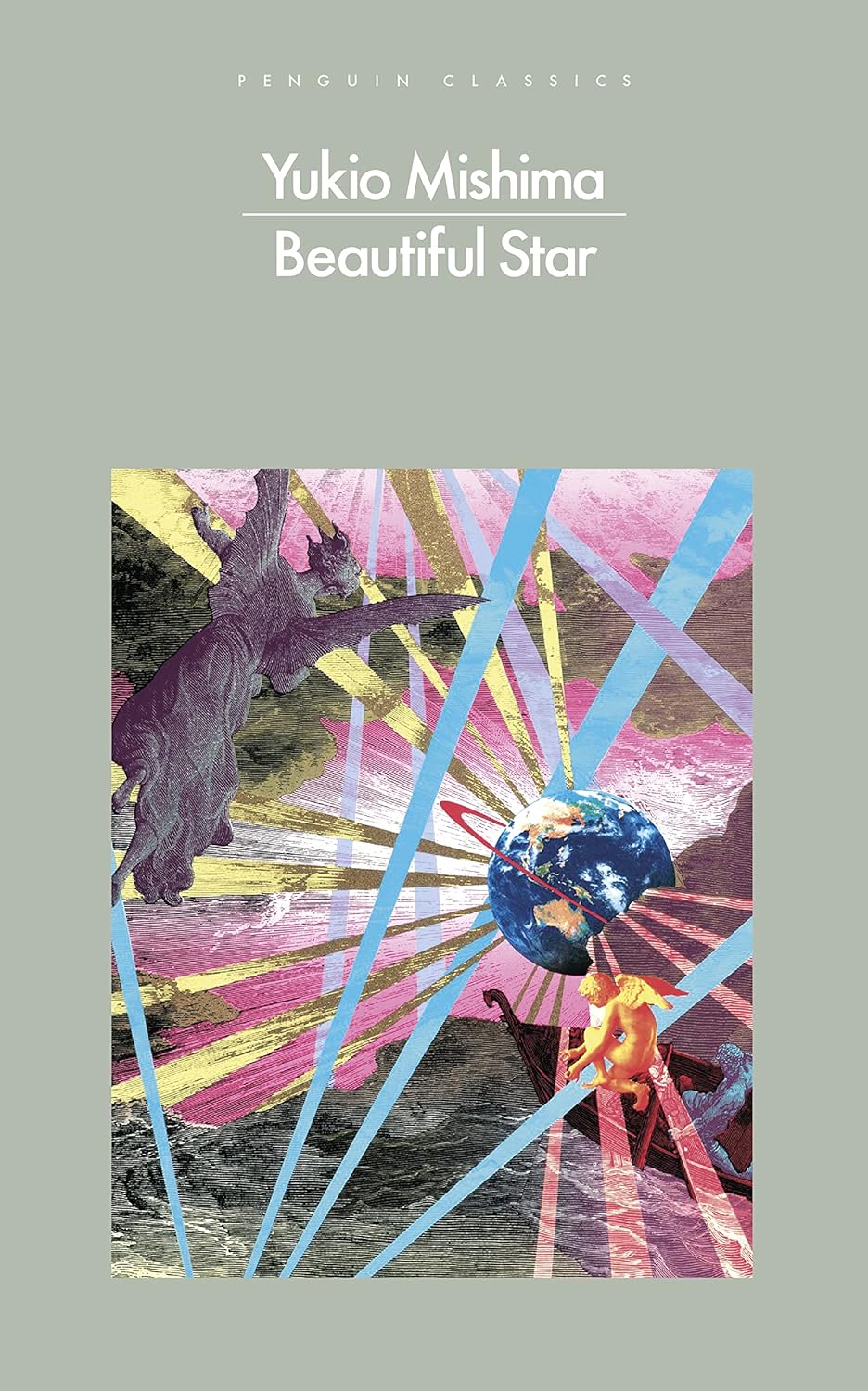
Despite the stereotype of Mishima as a heartless nihilist, cruelty is not viewed positively in his novels, however full of it they may be. A surprisingly potent example is Beautiful Star, published in 1962 but only translated into English sixty years later. The deadpan, absurd premise of this novel is that an ordinary middle-class family has spontaneously decided that they are all space aliens, each from a different planet. It begins with the father, Juichiro Osugi, who just has a vision of a flying saucer one day — who could ever have imagined that there would be any subject linking Yukio Mishima and Fr. Seraphim (Rose)? — but quickly spreads to the mother and children. Fortunately, the madness is relatively benign in this case, finding its main expression in a messianic quest for world peace. The family writes a letter to Khruschev, imploring him “to save the Earth and humankind from destruction, and summon up a dauntless spirit in order to eradicate for ever the threat of war by the accidental push of a button,” (Beautiful Star, 24) and founds a “Universal Friendship Association in the pursuit of world peace,” (16) which attracts plenty of sympathizers, many of them similarly damaged.
The situation becomes even more ridiculous when a group of antagonists emerges, led by one Masumi Haguro, “an assistant professor at the local university, lecturing in legal history,” whose first thought when he appears is that “humans were ugly, and the reason why flowers never bloomed out of the frontal lobes of humans was because they never got pruned. They ought to have their fingers and toes smashed when very young. His students at university were so unattractive and dimwitted…” (88) The two other members of the group are, by his own assessment, “an uncouth barber and a nondescript student, but he found himself in a situation where these two were the only ones standing before him. What other choice did he have?” (93) He has a revelation of his own:
(Beautiful Star, 94-95)
They come together because “none of them was much of a looker, they were all driven by constant hatred towards people, and they had equally harbored a long-standing vague hostility towards the whole of mankind.” (95) Their misanthropic discussions are remarkably similar to the meetings of the boys in Sailor. Eventually they fixate on the Osugi family as their enemies of choice, but, lacking any capacity for physical violence, all they manage to do is show up at Juichiro’s doorstep and harangue him. The debate about whether humanity should be saved or eradicated lasts fifty pages, but since Juichiro doesn’t budge from his compassionate stance, it devolves into them piling verbal abuse on him and leaving in a huff. I suppose it is the closest that Mishima ever came to writing a comedy.
It is fortunate that Haguro’s group is so inept, because the Osugi family is totally defenseless. At one point, Juichiro’s daughter Akiko is seduced by a young man who pretends to believe her story (and poses as an alien himself). But, even when she is four months pregnant, she remains utterly convinced: “Remember what you once said. We are not humans, we must never forget that. Not for a moment. An immaculate conception. I didn’t mention it to the doctor because trying to explain would have been pointless.” (127) Juichiro tries to track down her lover, only to find that he has long disappeared. And, finding himself totally powerless, the only thing he can do is tell her, “Turns out he was from Venus. He’s left you behind and returned home.” (143)
Juichiro is even weaker than Ryuji. “As a young man, he had been tormented by an inferiority complex. Held in contempt by his father, a complete philistine, he had sought salvation in the gentle and forgiving world of the arts… During the earlier, inactive phase of his life, he was the sort of person who could not stop wondering why, for example, the top branches of garden trees were slenderer than their trunks, and why these branches shorn of leaves became so delicately embedded into the blue sky.” (8) But there is an unmistakable gentleness in this description. It is precisely because Juichiro is totally unable to protect either himself or his family that his delusions acquire a kind of integrity. To him, Haguro and the other two losers are dangerous extraterrestrial adversaries, and it really does fall to him to be the sole voice standing up for human life: “My task is simply to gather together all aspects of the human character, from precious stones to trash, as long as they contribute to the attainment of peace.” (207-208)
At the end, an over-stylized but still remarkable dialogue takes place between Juichiro and his daughter, who has finally realized that her lover had not been an alien after all:
(Beautiful Star, 220-223)
To use the bait of truth to create dreams…a fitting epitaph for any writer. What is any book but a dream? The better the book, the more cruel the dream. A miraculous world, more vivid, more alive, more detailed than so-called reality, that vanishes the moment you close it. And leaves you more alone than you were before, wishing that you could have stayed in that world, a world with real people and real feeling. But there is nowhere to go, no door to break down. All that remains is to weep over stories from old novels because there is nothing “real” worth weeping over.
Yet, Juichiro receives his consolation. Like Honda, he spent his whole life separated from the world of sensation and experience: “As Juichiro gazed at the dry, wasted muscles of his hand, he dreamed of the ephemeral but glorious flesh of vibrant humanity.” (226) But at the same time, “this was unquestionably a sign that he had foiled the plot hatched by those sinister aliens from the unknown planet of 61 Cygni. Thoughts of sacrifice arose in his heart. Maybe it was the will of the Universe to save all mankind in exchange for the sacrifice of a single Martian called Juichiro, and he had just been unaware of the plan until this moment.” (227) Indeed, in the closing pages, the entire family is consoled, after a fashion. Perhaps they are the only characters in all of Mishima’s novels who are. Mishima was not a writer to dole out kindness generously; seeing it here means that it mattered to him. Just that alone gives Beautiful Star a certain significance.
But, to bring us back to earth (literally), we have found plenty of parallels for Toru’s petty cruelty throughout Mishima’s work, and this quality is generally found in characters who are overtly repulsive and laughable. On the other hand, what seems like “weakness” at first glance, a quality that one would expect Mishima to abhor, sometimes turns out to contain unexpected complexity. Toru clearly belongs on the same side of that divide as Noboru and Haguro. So, conceptually, there is a certain logic in making him a false incarnation, a debased parody of Kiyoaki, Isao, and Ying Chan.
And yet…it is not quite that simple. The parody comes uncomfortably close to the original at times. And, as we saw before, there had already been an element of parody in Isao as well, and a peculiar ambiguity in Ying Chan. Moreover, Kiyoaki himself always had a considerable cruel streak. While Toru is being raised by Honda in Angel, he devises an elaborate deception of his girlfriend, a pampered daughter of a rich family. This involves writing and delivering a compromising letter, which is oddly reminiscent of Spring Snow, where Satoko first read a letter that Kiyoaki had asked her to burn, then he burned another one that she asked him to read, and finally he lied about it to her in order to force her to meet him. The only saving grace there was that Satoko likely saw through the lie, or decided that it didn’t matter. But it was, unquestionably, an attempt at blackmail.
Kiyoaki is absolved (if such a word can even apply here) through his suffering. But, even when he is in despair, even when he is dying, Satoko’s suffering never once becomes real to him. He remains, to the end, a selfish, spoiled child. Toru is incapable of real emotion, but his absolute coldness is not something totally removed from Kiyoaki, either. And, in fact, he is capable of suffering, as well. When he is deprived of death at twenty, he accepts his fate with grim stoicism:
(Angel, 218-220)
The word “fraudulent” is used here. But, of course, easily recognizable in this passage are precisely the “five marks that death has come to an angel” (Angel, 51) — soiled clothes, faded flowers, sweat, foul smell, and indifference. And that should be very alarming, because these are not merely the signs of death; they signify the death of an angel. One has to be an angel in order to die in this way. Therefore, Toru was an angel.
What does that mean? Perhaps he truly was the reincarnation of Ying Chan. Reincarnation itself may very well continue forever. But, at some point along the way, the very essence of what is being reborn became old, worn out, depleted. We already saw this in The Temple of Dawn — Ying Chan, born to soar, to transcend her own beautiful body, and yet remaining trapped in reality, because the world no longer offered any means of escape. Now, the next incarnation is no longer able to die at twenty even if it wants to. The spirit itself has decayed. The very metaphysical framework of the universe has become hollowed-out. The cold, impersonal mechanism of reincarnation has no more room for miracles.
While Toru is still a teenager, Honda instructs him on cynicism and how to manipulate people, and suddenly has “the feeling that these were really instructions for Kiyoaki and Isao and Ying Chan. Yes, he should have spoken to them. He should have armed them with the foreknowledge that would keep them from flinging themselves after their destinies, take away their wings, keep them from soaring, make them march in step with the crowd.” (113) It’s not clear what that would have accomplished, exactly, but perhaps it is just an expression of resentment — not so much of Kiyoaki and the others, but of a universe that allowed them to exist and never gave Honda himself any wings at all. Honda may have adopted Toru out of some unconscious desire to stamp out something in the universe that he himself had never been granted, a kind of petty revenge. Or maybe, deep down, he wants the universe to defeat his efforts, to prove to him that nothing could have made Kiyoaki, Isao, and Ying Chan “march in step with the crowd.” But the universe doesn’t hear him.
And so, having reached the end of his life, Honda goes on a pilgrimage to Gesshu Temple, deliberately retracing Kiyoaki’s steps from sixty years ago. Satoko, who became Abbess a long time ago, comes out to meet him.
At this point, Satoko is the last link to Spring Snow that still remains in The Sea of Fertility. A few characters had made very brief appearances in The Temple of Dawn, but by now they are all gone. “She faced him across the table. The nose was the finely carved nose of years before, and the eyes were the same beautiful eyes. Satoko had changed utterly, and yet he knew at a glance that it was Satoko. The bloom of youth had in a jump of sixty years become the extreme of age, Satoko had escaped the journey through the gloomy world. A person who crosses a garden bridge from shadow into sunlight may seem to change faces. If the beautiful young face was the face in the shadow, such, no more, was the change to the beautiful old face now in the sunlight.” (232) For a split second, the hateful years are erased, and Honda finds himself back in the one world, maybe the one moment, where he truly belonged.
But when he mentions the circumstances of his previous visit, Satoko replies, “Kiyoaki Matsugae. Who might he have been?” (233) And when Honda, astonished, tries to explain…
(Angel, 234-235)
One can feel what should come after Honda’s last words: And perhaps there has been no Japan.
Spring Snow begins with the lines, “When conversation at school turned to the Russo-Japanese War, Kiyoaki Matsugae asked his closest friend, Shigekuni Honda, how much he could remember about it. Shigekuni’s memories were vague… Their classmates who talked so knowingly about the war were for the most part merely embellishing hazy memories with tidbits they had picked up from grown-ups.” (Spring Snow, 3) Kiyoaki gazes at an old photograph of soldiers assembled for a memorial service. It had been taken in 1904, less than ten years ago, but it has already taken on an unreal quality: “The figures of these soldiers, in both foreground and rear, were bathed in a strange half-light that outlined leggings and boots and picked out the curves of bent shoulders and the napes of necks. This light charged the entire picture with an indescribable sense of grief.” (4) In other words, from the very first page of The Sea of Fertility, itself set in faraway 1912, the memory of this formative experience in modern Japanese history has eroded.
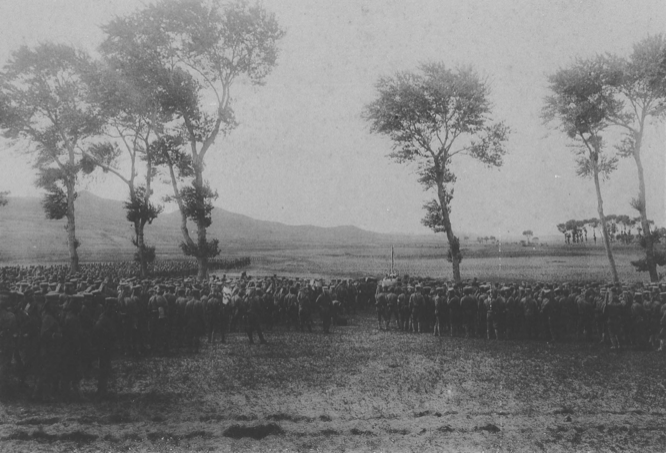 The photograph.
Japanese literature coalesced into existence in 1905, when Natsume Soseki published I Am a Cat, and perished in 1970, on the day of Mishima’s suicide. 1905-1970. Picture those years as dates on a tombstone. In 1970, the world of 1905 had become totally unimaginable. And there were people like Honda, whose lives covered that entire span! In his old age, he begins to dream, and sees a scene from his childhood:
(Angel, 42-43)
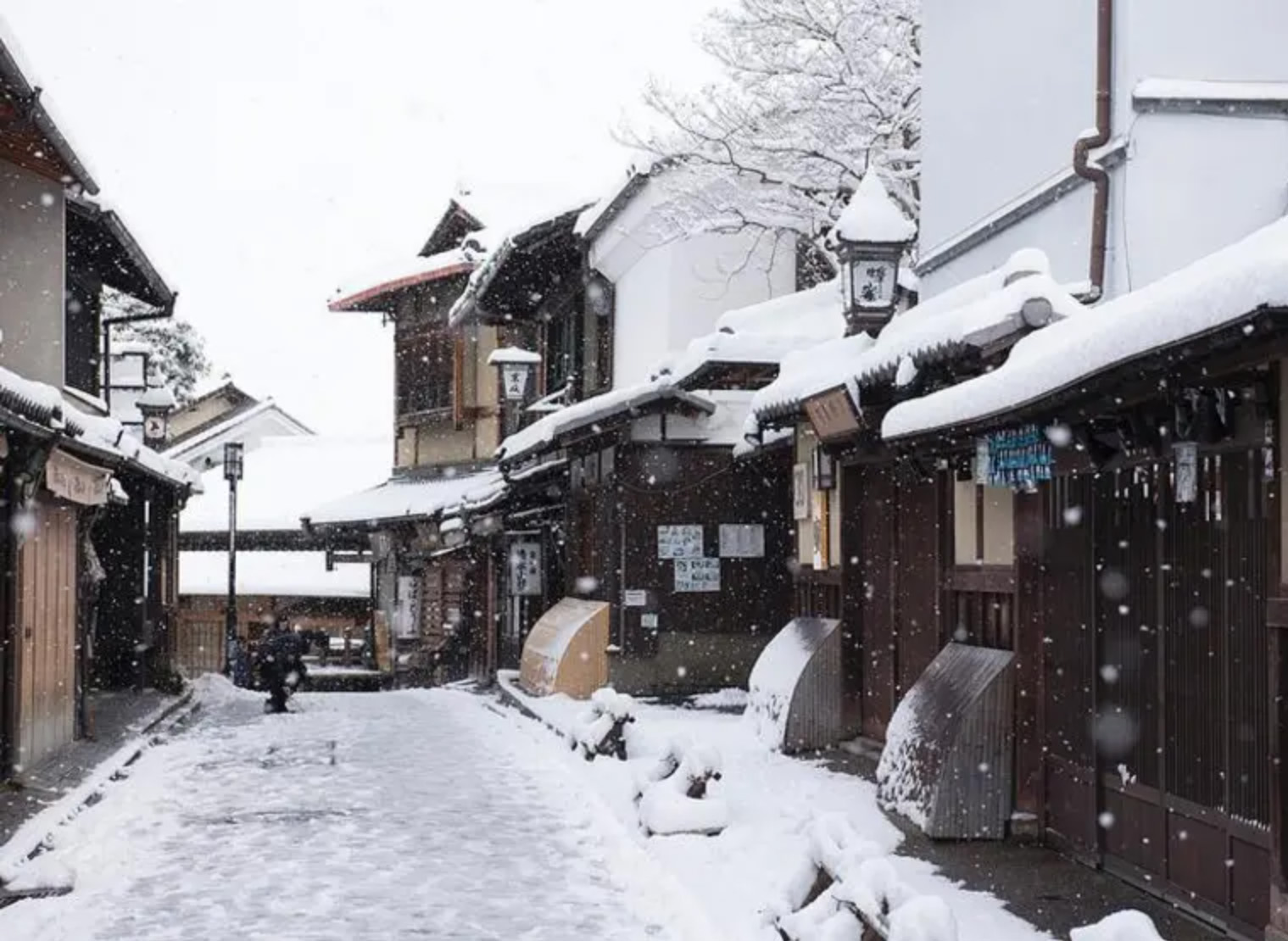
This is all that remains. It doesn’t amount to a clear picture of everyday life at that time, or even a single coherent “scene” in the sense of theater or film. A fragment, a half-remembered taste, a vague sense of warmth, “a sort of pleading, as if he had buried his face in her warm bosom.” (Angel, 43) You can’t even explain that to another human being in words, not that anyone would listen if you could. It is so elusive that there is no way to share it. And this is something that happened in your own life. This isn’t time eating away at our understanding of history, or of past generations, or other matters far removed from our lives. This is our experience of ourselves. Live long enough, and you will feel pieces of your identity falling away, with nothing to take their place. It has nothing to do with illness or old age; Mishima was 45 and in prime health when he wrote this. In a sense, history — time itself — moves faster than a single human life. Physical reality is more ephemeral than memory. It is not surprising that human beings eventually outlive themselves, but it is shocking how quickly this happens. We simply live too long.
From the vantage point of The Decay of the Angel, the previous three novels — and, together with them, the rest of Japanese literature, including Sanshiro with its innocent play-acting at city life, Snow Country with its sensual sadness and hidden cruelty, and The Makioka Sisters with its busy family routine — really do begin to look like a jumble of completely unrelated, incomprehensible images. What does any of this mean anymore, and for whom? Pieces of someone else’s memories, vivid dreams that dissolve into nothingness the moment you wake up. Where was Japan in all this? Don’t you suppose, Mr. Honda, that there never was such a nation?
To Honda, Satoko’s answer feels like a betrayal. And not only to him. Maybe I need Spring Snow to be “real,” at least within its own fictional world, even more than he does. Maybe Spring Snow is my own youth, more surely than whatever “really” happened. I first read it when I was Kiyoaki’s age, and now it has become permanently fused with my own life, to the point where reading it again makes me remember, not only the details of the story, but the precise thoughts and emotions that I had experienced while reading it back then. And that is the only way that I can remember them. A window into, not early 20th-century Japan, but my own past, like my younger self is superimposed onto me and turning the pages at the same time. And if Satoko turns her back on its reality, maybe some light in me also goes out.
But what can Satoko tell him? It all happened sixty years ago, in another world. The physical traces of that world disappeared even before the memories of it did. In The Temple of Dawn, Honda wanders by the site of the old Matsugae house during the war, and finds that nothing remains: “The pond and the artificial hill in the garden appeared as poor miniature replicas of the once magnificent lake and the maple-covered mountain of the old estate… He realized that the plot had been reclaimed by filling in the former extensive pond.” (Dawn, 134) In a strange way, when the bombing destroyed all the new buildings that had sprung up on the former estate, it cleared the room for Honda’s memory to fill in what had once existed: “The contours of the land had changed, but across the desolate expanse Honda could still single out the location of the pond, the shrine, the main house, the Western-style wing, and the driveway in front of the porch. The outlines of the Matsugae house that he had frequented were clearly etched in his memory.” (135) But that was the last time. By the time of Angel, that delicate reconstruction has also slipped away. There is no point in calling any of this to mind anymore. There is no one left to understand or bear witness, and it doesn’t even feel like one’s own life. Satoko is right — it may as well never have existed.
In Dawn, Honda delves into a branch of Buddhist theology that interprets time as “thin slices of instants, infinite in number, pierced through by the skewer of the seeds of the alaya consciousness. And the thin slices representing so many instants are both pierced and discarded in each minute segment of time.” (128) That is, two moments in time may be indirectly connected in a certain way, but nothing ever persists beyond a single moment. In that sense, there is no past and no future, and nothing can exist continuously through time. The universe is destroyed in every instant and something else is created; the you that exists tomorrow may resemble the you that exists today in some accidental fashion, but it will not be the same you, and therefore, it may not really be “you” at all. As I wrote earlier, this is certainly one way to interpret the dizzying, unbelievable trajectory of Japanese culture and history in the 20th century — to make sense of it by accepting that there was never any sense in it to be made. There is something comforting about that, especially when you expect to die in a bombing at any moment.
But without a past and future, there can be no present either. After meeting Satoko, Honda is shown outside. “There was no other sound. The garden was empty. He had come, thought Honda, to a place that had no memories, nothing. The noontide sun of summer flowed over the still garden.” (Angel, 236) And The Sea of Fertility ends. Because when memory is gone, there is no longer any need for life. Or for reincarnation. Or for nationalism. Or for literature.
All that may be wrapped up under the neat word “nihilism.” Mishima’s nihilism, they call it. But…it isn’t really possible to be a nihilist, after all. The human heart rebels against this belief. All right, so the past doesn’t exist, the present is meaningless, and nothing is real. Then what is it that leaves me with this sense of loss? Why do I still need there to be something beautiful, even if only in fiction? Everything may be an illusion, but not that grief. The things that aren’t there are the most painfully real of all.
 Fallen Leaves
YES! He’s back
LikeLike
These may have been the thoughts of a guard of that military base on November 25th, 1970 (maybe he was a Mishima fan)
LikeLike
Greetings
I’m an Orthodox Christian who also follows the Old Calendar and was searching for posts on Mishima’s The Sea of Fertility, my favorite book of secular world literature.
Please contact me on this e-mail, I’d love to establish a correspondence:
[Edited for privacy. -FL]
Wish you a blessed Holy Week
LikeLike
Thank you for reading (and forgive me for taking so long). If you have any thoughts on the site, I’d be happy to read them in the comments. Blessed Theophany!
LikeLike
I finished this series today, as a young man before Kiyoaki’s age. I’m glad I read this series. I was running around trying to make sense of the world for so long and failing to comprehend it, and these books have shown me, along with your commentary, that there is no sense to be found in it.
I pray that this moment of comfort found through knowing I am ephemeral lasts for longer than I know it will. Thank you.
LikeLike
I’m not sure that is the conclusion of The Sea of Fertility. It mourns the loss of meaning, but one can only feel the loss of something that existed. Or, to put it another way, if something can be felt only through its absence, that is also a form of being.
Thank you for reading.
LikeLike
Amazing analysis! I feel as though The Sea of Fertility is the best thing I’ve ever read. Part of the struggle is that I don’t want to take away the wrong lessons from it. I first tried reading it when I was 17, but I was having some personal issues and could relate to Kiyoaki to an extent and it was upsetting me so I quit. I’m 19 now, turning 20 in a couple months, and recently had surgery on my foot leaving me at home bedridden for some time and I was finally able to binge read the tetralogy. I am very glad I waited till I was older to read it because I’m able to empathize with Honda (and even Toru to an unfortunate extent) more than I would’ve if I had read it when I was younger. I am also glad I didn’t read it at 17 because I was pretty impressionable and would’ve gotten very depressed over the ending.
Not to be an over-sharer, but I have a lot of dissatisfaction with my own body and have felt as though it is turning against me on multiple occasions. I started balding at 18 near the end of my last year of high school, my feet are relatively deformed at the ankle which is why I’m spending a good chunk of this year in post-op physical therapy, and I had an ER trip because my throat had been closing up requiring medical intervention to fix my throat and I still fear that I am going to choke at any point when eating and die pathetically. I get that my rambling sounds like self pity, and it is to a degree, but this series has given me a sort of salvation emotionally. I believe this series hit me much more personally once I became able to hate my body, and I have so much appreciation for it in that regard.
Anyways, The Decay of the Angel, while I feel it is rushed in its writing quality and lacks some aspects that made the previous three books feel like masterpieces, I think it is actually my favorite. I have read two other books in the month since I read Decay and I feel that I’ve been unfair to them since I have been unable to stop thinking about it the whole time. The ending leaves me with so many conflicting emotions. I’ve looked for so many different interpretations of it online since I struggle to tell if I had the right takeaway from it. It would be much easier for me to digest if not for the fact that Mishima killed himself in a similar fashion to Isao from Horses. It also doesn’t help that the ending is relatively open ended and since Mishima himself wasn’t alive afterwards to talk about it, it leaves me wondering what to think.
There is the one obvious possible takeaway and that is to take Satoko’s words as fact. There is no soul, there is no I. This is something that Honda himself seemed capable of digesting to a degree in Dawn because he accepted the idea of the Yuishiki Doctrine and tried living by it for a little bit, like when he walked through the destruction caused by the war and pondered on how in every instance, the world ends and is reborn. Honda’s main flaw here is that he was focusing on that aspect, yet was never able to reject the soul. He lived his life chasing after meaning in finding Kiyoaki’s forever reborn souls. There are two main things that make me feel conflicted with this ending. For one, all signs really do suggest that Isao was Kiyoaki’s reincarnation, and that Ying Chan really was Isao’s. I know that some people interpret the ending as it all have been Honda’s mistake in finding these connections and that they really didn’t matter, but multiple instances of Isao’s life feel like they were directly taken from Kiyoaki’s dream journal, and then of course Isao wished to be reborn as a woman and then Ying Chan came along claiming that she was a reincarnation of someone in Japan. Of course, she was said to be “retarded”, but she did still say those things. It isn’t like the books are from a first person point of view with Honda. The narration explicitly showed that. Though I could be wrong as Ying Chan was never showed on her own. She was only ever present in scenes where Honda was also present. Even with that aside, as you pointed out, Toru really did exhibit the signs of decay. It would feel redundant to show that and him have not been an angel. Maybe he really was a reincarnation, or maybe him being an angel (in the sense that Honda sees it) doesn’t outright make him a reincarnation and that is a separate thing entirely. The one thing that holds true in my mind is that Toru was pure in some aspects. He was pure of decadent apathy. Like you said, maybe he was an angel, and he just decayed instead of dying at 20. The reason I bring all of this up, is that it would seem counter to Satoko’s point of there being no I when this all seems to disprove it in my eyes.
There is also the conflict that is Mishima’s suicide. If we are to take Satoko’s lesson at face value, then the idea of a self being false would make Mishima’s choice to die have to be different from Isao. It is true that Isao just wanted to commit seppuku to an extent and even when he did commit the political assassination, he reasoning for doing so was a relatively insignificant one that the story makes it clear he chose just to have a reason. Maybe Mishima was the same way. But what conflicts with me is that if all of that in the story with Kiyoaki, Isao, and Ying Chan was a lie and that there has been no I the entire time, then why would Mishima still choose to die that way? Satoko is one of the most interesting characters in the whole series to me, because she is the antithesis of the youthful purity that Mishima describes, yet she remains beautiful and never decays. To me, that is a sign that she is the answer to everything. I’ve heard people try to say that the idea with the story is that the story was actually anti buddhism and that the story makes a point of showing that it isn’t a fully Japanese idea as a metaphor for Japan losing its own identity and that buddhism was the reason for Honda’s downfall, but that completely contradicts the ending in my eyes since Satoko remained beautiful. For me, Satoko was the answer to everything in the story. If buddhism really was trying to be painted as a bad thing, then why would Mishima have made Satoko remain beautiful and never experience decay? For me, the issue really is that Honda was never able to reject the self. Maybe if he was able to, then he would have been just as beautiful as Satoko all those years later. What really just makes it hard for me to accept the ending (even though I love it) is that Mishima himself still chose to die like Isao. It really leaves me thinking that maybe he really was just very depressed, but then I start thinking that I am making assumptions on something I wasn’t there for so I can’t figure out if I’m having the right takeaway from the ending. Also, if that is the true moral of the story and it is just very nihilistic, that leaves me as the reader feeling pretty depressed. But the man died, so maybe it is supposed to be. All in all, I loved your review, though I had to skip over certain portions where you talked about his other books since I don’t want spoilers, and I loved this series. It’s been a long time since I’ve read something that’s impacted me as much as this has and I am very grateful for it.
LikeLike