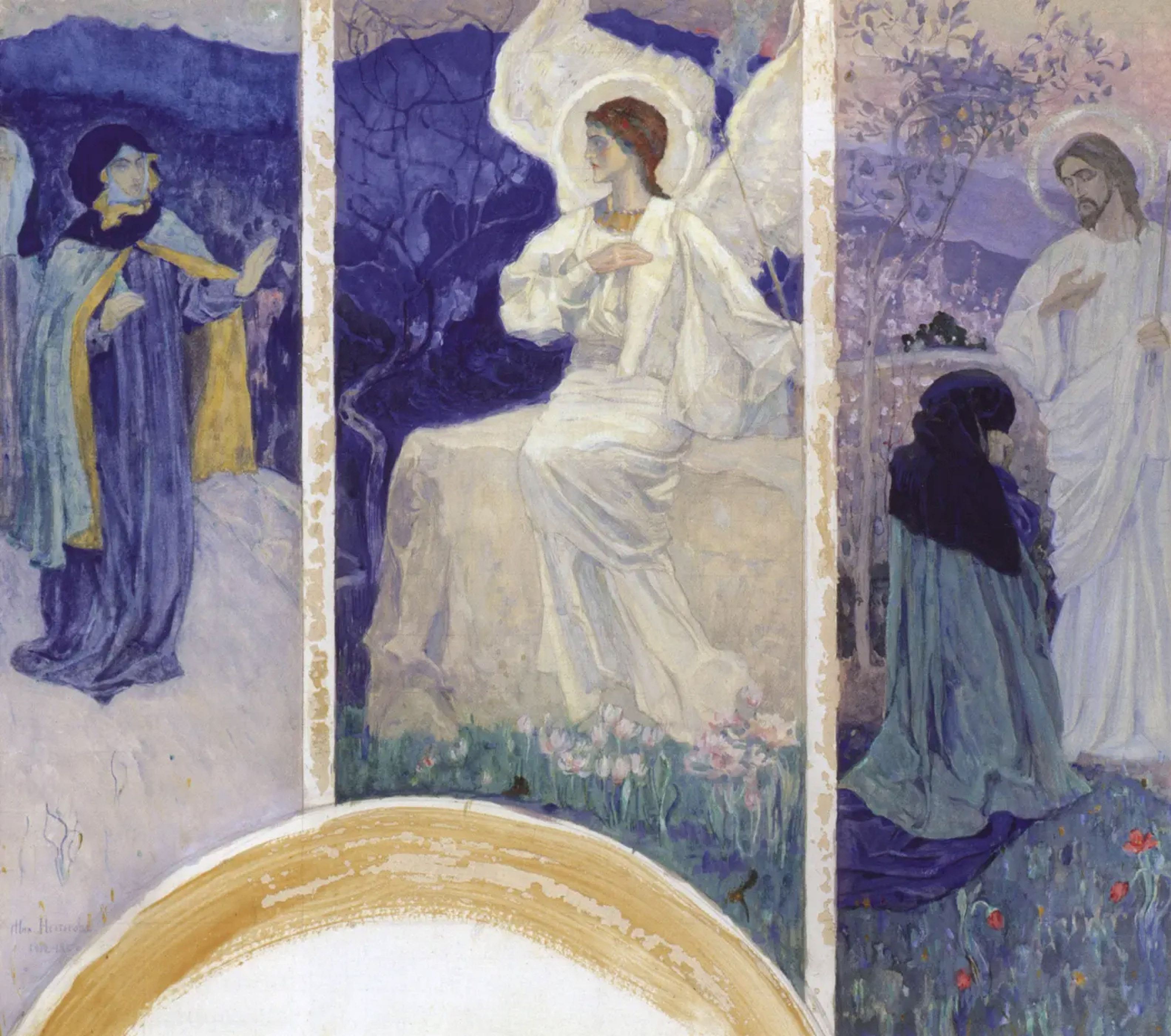
 Fresco of the Resurrection. Mikhail Nesterov, 1909.
Fallen Leaves wishes its readers, whoever they may be, a happy Orthodox Easter.
There are times when words fail. One simply stands there in the dark, trying to hold on to the feeling of the apostles. The feeling of abandonment, loss, and animal fear (Peter’s denial). The certainty that these strange, beautiful, carefree days have ended, and all that remains is cruel, immovable reality. The world has no room for miracles. Life is brutally simple. There is only one thing that ever happens and it is always the only thing that ever could happen. And then… “Thy Resurrection, O Christ Savior, the angels hymn in the heavens.” The procession leaves the temple empty. One walks in the back, lagging behind, repeating the words in one’s mind. And everyone gathers in front again, to hear the priest announce that God is alive.
Some years it is easier than others. Some years one feels it immediately. A feeling of deep anticipation, from the moment the reading of Acts begins. Other years one grasps for it. Sometimes one stays home. Sometimes one comes back. Vasily Rozanov wrote in 1911, “Only 60 times, at best, could I stand all night ‘with little candles’ on Great Thursday: how could I have missed even one?!! Lord: give me 60 Easters!!! So few. Only 60 Nativities!!! How could anyone miss even one of these?!! There’s your reason to ‘go to church,’ the foundation for ‘the right way of life,’ with parents, with a wife, with children. I’m 54: and I’ve barely been there 12 times ‘with little candles.’ And it’s too late: already 54!” These words were wrenched out of him after a long intellectual rebellion, and just eight years before his death. But even before then, the beauty of Pascha was not lost on him:
“Christ is Risen,” 1907
The first post on Fallen Leaves appeared in 2017. At the time, I simply wanted to share my thoughts about Fr. Seraphim (Rose), without much of a plan for what would come after. I wrote much more than I had planned. I only had a vague notion that I might write about books. My writing took shape in medias res. In time, I realized that the entries I was writing were loosely connected. Fallen Leaves is a kind of nonfiction novel, dedicated to the culture of the twentieth century and how, in its collapse, it sometimes touched something timeless and eternal. It is also dedicated to the individual who is left alone among the ruins. And is crying, begging, howling for someone to answer.
By now, I have posted over 300,000 words, though much of that is quoted text that I believed I had to share. For some time, I thought that Rozanov might serve as a kind of unofficial final chapter. It would be fitting to close with the namesake of the project. That material is being written. But it need not be so categorical. There is no reason not to leave room for various afterwords — Bulgakov, for example, or Kawabata. Or other writing.
The cycle of Church services cannot be contained in any human life. The fullness of God sometimes feels like indifference because it is too vast to grasp. The Church does not know who just walked into the temple, and yet in a different sense it knows everything about them. To let one’s individuality float along the vast current of God’s love; to find comfort, but only for a single smouldering ember inside oneself; to let everything else fall away in pieces as the price of keeping that ember. “For what shall it profit a man, if he shall gain the whole world, and lose his own soul?” However painful it may be, that is the only comfort there is. The miracle of Pascha is eternal life, but perhaps the most that man dares hope for is something smaller — for there to be someone to hold his hand while he weeps for his own defective self.
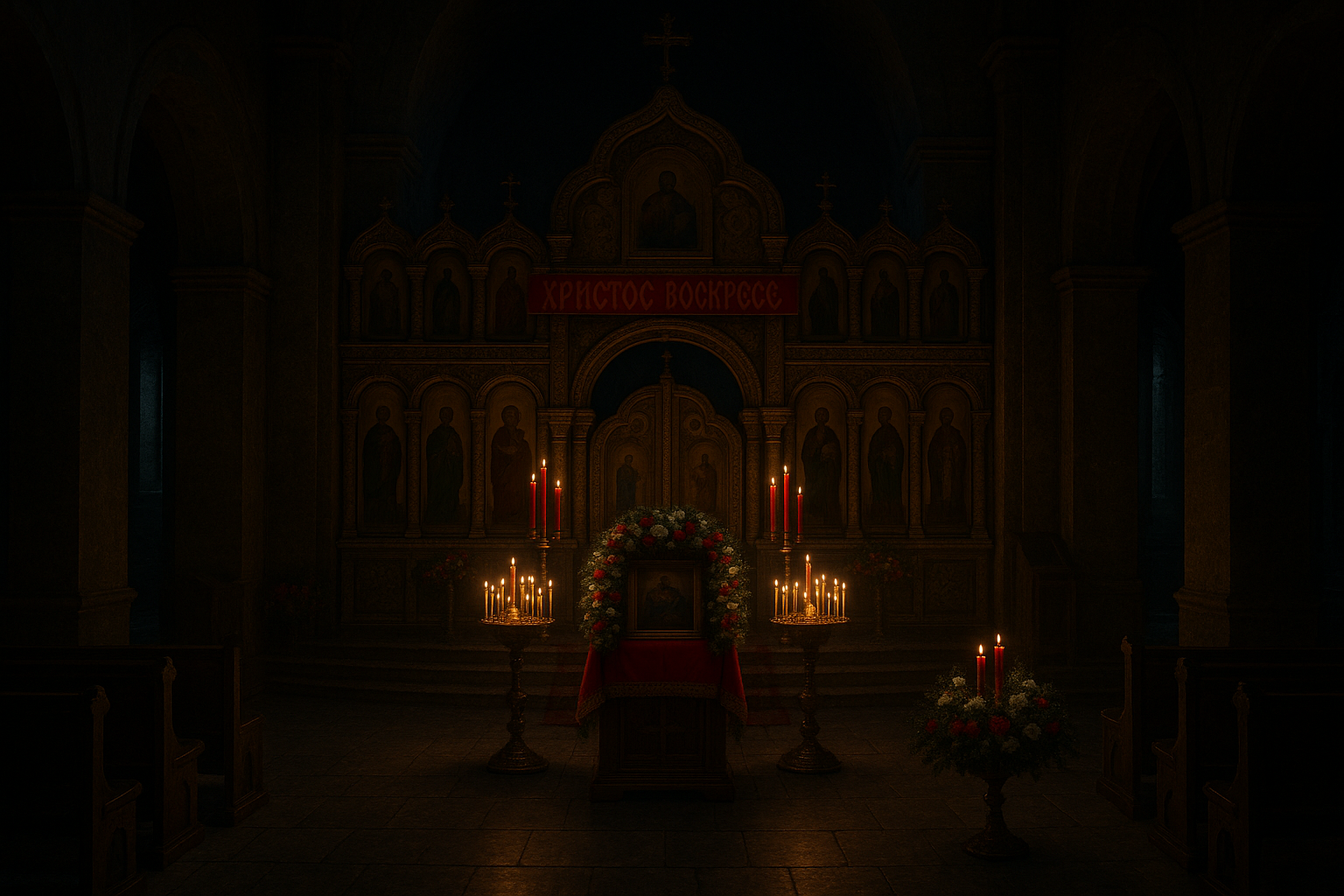 Христос воскресе из мертвых, смертию смерть поправ,
и сущим во гробех живот даровав!
 Fallen Leaves
And then Pope died after Catholic and Orthodox Easters coincided…
LikeLike
Your work here has been a great influence on me these past few years. It was at my first Orthodox parish that I learned of you to begin with (so there is some word-of-mouth about this in perhaps faraway or perhaps near Christian places).
LikeLike
Me and my wife love reading your blog and eagerly await each new post. I hope there’s more in the future. You’ve been a big influence for me.
LikeLike
Thank you — glad to have you with us.
LikeLike