
(Continued from part 2.)
Of the four novels comprising The Sea of Fertility, the odd one out is The Temple of Dawn. For instance, it is the only one of the four to be spread out over a long period of time, with the first scene taking place in 1941 and the last in 1967. Every other novel, including The Decay of the Angel, concentrates on a narrow time span. The focus of The Temple of Dawn is thus strangely blurred.
The plot is fragmentary. Most of it is contained in two chronologically distinct episodes (1941 and 1952). World War II takes place in the interim, but is almost completely absent from the narrative. In its place, there is a lengthy lecture on Buddhist philosophy serving as an interlude. Looking back, this is perhaps not quite as bewildering as it seems at first — it is, like many elements of the later novels, an outgrowth of a narrative thread in Spring Snow, where Honda contemplates “a unique theory of the Chain of Causation in terms of time” even as Kiyoaki is dying of fever. In fact, the discussion in The Temple of Dawn is largely a development of this brief theme: “According to the doctrine of Yuishiki, ‘awareness only,’ each of the various dharmas, which were actually nothing other than consciousness, far from enjoying permanence, existed purely for the moment. And once the instant was past they were annihilated.” (Spring Snow, 385) But there is a difference of scale: in Dawn, Honda’s ruminations simply take the place of whatever plot there is.
In a way, that is an apt description of the entire novel. There is a peculiar double similarity between The Sea of Fertility and War and Peace. Tolstoy’s epic begins with a wide array of characters, relationships, and social situations, painstakingly rebuilding a world that existed sixty years in the past, but as it progresses, much of this variety falls away, and the empty space is filled by the author’s reflections on the nature of history and Pierre Bezuhov’s solitary forays into numerology. Likewise, Spring Snow, serialized in the mid-1960s, is an intensely concentrated effort to recreate the long-gone Japan of 1912 — focused, like Tolstoy’s work, on the aristocracy — but by Dawn, the majority of its cast has died or disappeared. Prince Toin, who nearly married Satoko and then, in Runaway Horses, briefly toyed around with the idea of patronizing right-wing politics, no longer appears, but is briefly mentioned as having “lost his title after the war” and “bought up art objects cheaply from members of the former nobility overburdened with property taxes. He had opened an antique shop for foreigners.” (Dawn, 156) Well then, perhaps it is for the best that the marriage never took place. Kiyoaki’s parents are dead. Baron Shinkawa, the secret benefactor of Iinuma’s organization in Runaway Horses, appears in one scene as a degraded comic figure who, by 1952, “had fallen into the habit of accepting all invitations…everyone considered him and his garrulous wife to be the most boring of guests.” (176) Iinuma himself shows up for a couple of pages to beg Honda for money and cry crocodile tears for Isao. Several new characters appear, but they are only briefly sketched out. Really the world of The Sea of Fertility has narrowed to Honda and his thoughts. In The Decay of the Angel it will constrict even further.
Nonetheless, there is a plot; the world of Spring Snow, despite its physical destruction, still continues to influence events forty years in the future.
one of Kiyoaki’s dreams (Spring Snow, 82)
near the end of Isao’s life (Runaway Horses, 342)
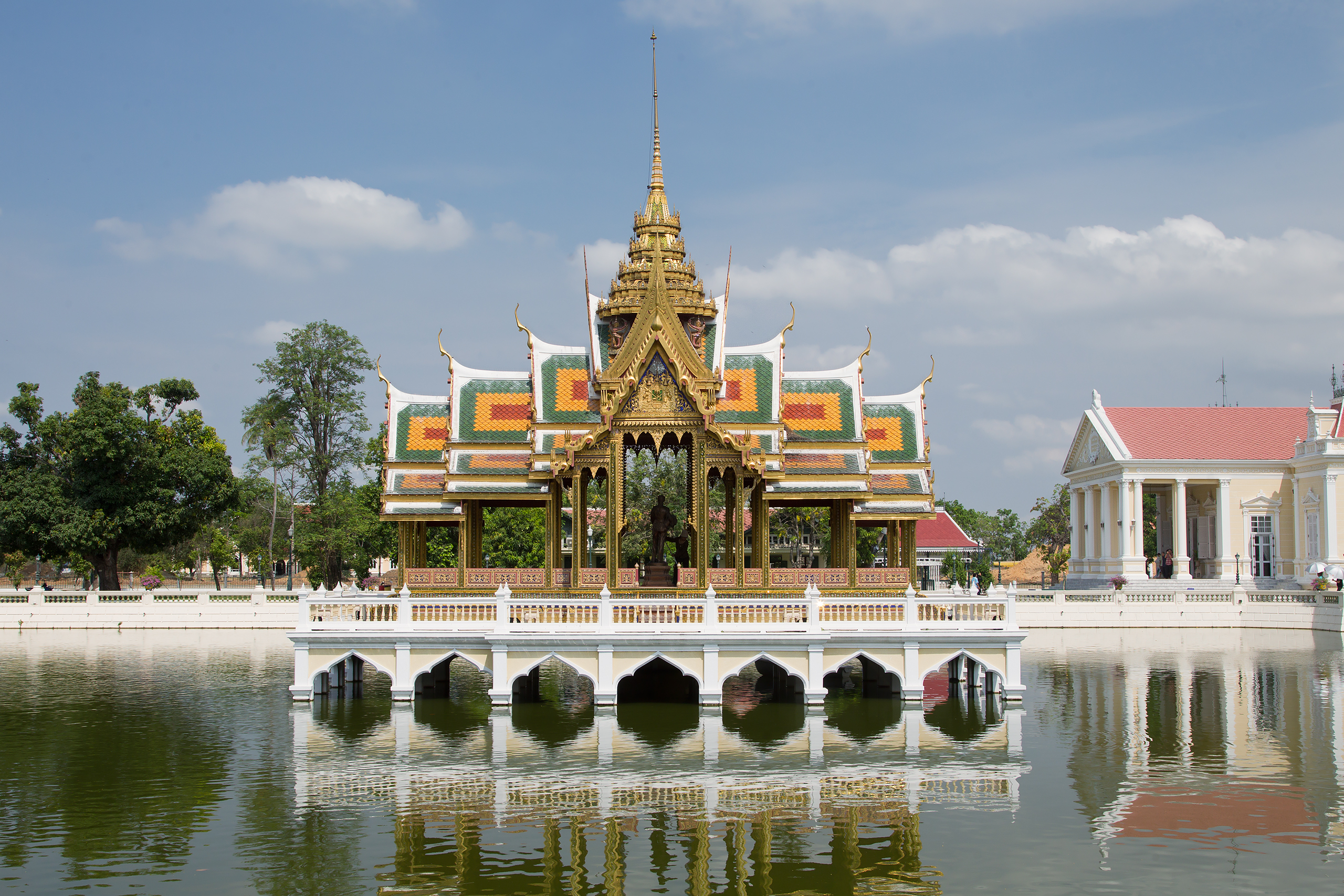 Bang Pa In Palace, where Honda saw Ying Chan.
And, indeed, Isao too is reborn, as a woman — a Thai princess, the daughter of Prince Pattanadid, who had stayed in Japan during the events of Spring Snow. This time it is not even a surprise. There is no shock, as there was in Runaway Horses when Honda first realized that Kiyoaki had been reborn as Isao. On the contrary, the little princess herself is even aware of it, insisting to her family that “I’m not really a Siamese princess. I’m the reincarnation of a Japanese, and my real home is in Japan.” (Dawn, 19) Visiting Thailand on business, Honda asks for an audience with her, and, again unsurprisingly, “suddenly glimpsed a black shadow flitting by the window frame. He shuddered. It was a green peacock. The bird perched on the sill, stretching its long elegant neck that glittered a greenish gold.” (37)
All this is very strange. Like the novel itself, Ying Chan is the odd one out among the “incarnations.” She is the only woman, the only non-Japanese, and the only one to show any awareness of her transmigration. Thailand thus takes on a unique significance in Mishima’s work — very few of his novels venture anywhere outside Japan at all — and yet it is impossible to grasp the precise meaning of it. When Ying Chan appears again in 1952, all she has to say is, “They all tease me about having been slightly mad… But I’ve completely forgotten everything…and the only thing I remember about Japan is that I used to love a Japanese doll someone [Honda himself. -FL] gave me.” (200) That is nearly the entirety of her spoken dialogue in the second half of the novel, as Honda is never able to have her to himself again.
But when he first meets her, Honda takes a peculiarly blasé attitude toward this latest manifestation of the supernatural. It motivates him to travel to India, the very source of Buddhism, where he sees a procession of surreal, grotesque imagery, recorded with documentary accuracy by Mishima, who himself had traveled there:
(Dawn, 56-57)
 “The Mani Karnika ghat offered the ultimate in purification…
Beyond question this location marked the end
of the world.” (Dawn, 65)
For the most part, Honda reacts to all this with the same detached contemplation as the author. Various feelings run through his mind, e.g., “He experienced an animal-like emotion. It was the mixture of joy and anxiety which he always felt when something was about to take shape in his mind… Honda’s heart was turbulent with expectation.” (78-79) But after all, no specific shape is taken. There are many philosophical thoughts expressed throughout The Sea of Fertility, but, in retrospect, their significance is quite fleeting. For example, in Spring Snow, Honda tells Kiyoaki, with apparent ardor, “There isn’t much chance now to die on the battlefield. But now that old wars are finished, a new kind of war has just begun; this is the era for the war of emotion. The kind of war no one can see, only feel… But it’s begun in earnest. The young men who have been chosen to wage it have already begun to fight.” (Spring Snow, 198) But now, thirty years later, Honda remarks to himself with irony that, “In place of the era when Kiyoaki had perished on the battlefield of romantic emotions, a new period was coming when young men would die on real battlefields.” (Dawn, 18) The conviction with which words are spoken by Mishima’s characters should not be mistaken for the author’s. The same character can later say the exact opposite thing with the same belief.
Gazing upon Benares, “a city of extreme filth as well as of extreme holiness,” Honda does not behave like a man who has achieved enlightenment, or uncovered the secrets of the universe. One could, perhaps, argue that Mishima found in India a vision of “holiness” that can appear only when existence is pushed to the furthest extremes: “Everything hovered in the air like steam evaporating from ordinary reality.” (59) Extreme violence, extreme deformity, extreme filth work just as well for this as extreme beauty or purity. That sounds “Mishimaesque” enough. And yet, Mishima’s description of India is clinical and distanced, perhaps because we are looking through Honda’s eyes. The images are vivid, but do not evoke any particular emotion, and therefore, this “holiness” of death and pestilence is, ultimately…irrelevant. It is a mechanical process that has no real bearing on human experience, and transpires as if on its own, even though humans are ostensibly involved in its rituals. It diminishes the world, it takes all the wonder, the fear, the impossibility out of Kiyoaki’s rebirth. Honda even notes, ruefully, “The most frightening thing was that all mysteries, including the miracle of transmigration, finished by being cut and dried.” (158)
Mishima’s actual philosophical beliefs, if he had any, may be impossible to reconstruct. The lengthy excursions into Hinduism and Buddhism in The Temple of Dawn tempted critics to read some kind of mystical nihilism into his work, one example being Marguerite Yourcenar’s essay Mishima: A Vision of the Void, in which florid language substitutes for insight. But if you happen to be searching for a dissertation topic in the realm of Japanese literature, let me suggest “Mishima as Platonist” as your thesis — at least, it hasn’t been tried before, and it’s no less plausible than the “Buddhist void” angle. Especially since Plato was also fascinated by the concept of rebirth.

(The Temple of the Golden Pavilion, 25)
Rarely has there been a more elegant literary depiction of a Platonic hierarchy, ascending from the model to the physical temple to the idea of the temple, each one being connected to the others while remaining distinct. In Spring Snow, of course, there is an explicit distinction between Kiyoaki’s physical beauty and the “true beauty,” the pure idea, that emerges only in his suffering. And in Kyoko’s House, the boxer Shunkichi, who “exclusively despised the process of thought,” (Kyoko’s House, 106) priding himself on his utter lack of inner reflection, nonetheless encounters the world of ideas directly:
(Kyoko’s House, 257)
Though Shunkichi may believe in action for its own sake, it is very noteworthy that his action here has a purpose beyond itself — namely, to break through the physical reality of boxing to the “boxer’s universe,” the true idea of boxing that exists at an insurmountable distance from the fight itself. This is a very different angle from which to view Mishima’s fixation on physical fitness. Describing a different character in Kyoko’s House, Rankin writes, “Osamu decides to start lifting weights. At the gym he comes under the influence of a bodybuilder named Takei, who, in the implausible eloquence that is typical of Mishima’s characters, lectures him on the profundity of surfaces… Osamu is encouraged by this line of reasoning. While lifting weights he feels he is reaching out to existence for the first time in his life.” (Rankin, 83) But, by the end of the novel, “we hear that Osamu is dead. Apparently he has killed himself in a suicide pact with his sadistic lover,” who had previously coerced him into allowing her to cut his body. Rankin concludes, “Osamu is in love with his image, and although he thinks he is acquiring a greater realness through his gym workouts and his skin-cutting sessions, in fact he is denying the possibility of his real self even further. This is the psychological process that coincides with the death drive…his masochism only increases as he grows more confident about his physique and his physical existence, a paradoxical pattern that we can also observe in Mishima himself.” (85)
Unfortunately, this interpretation requires omission to be plausible. In between the “gym workouts” and the “skin-cutting sessions,” Osamu attempts to fight a gangster who has taken to loitering inside his mother’s store. But, of course, bodybuilding confers no combat skill, and he loses immediately: “Osamu covered his head, his powerful but sluggish muscles were of no use: he slid to the floor. He felt the strong blow of a dirty shoe upon his back, but when he came to, the man and the woman had vanished already.” (Kyoko’s House, 289) In other words, bodybuilding has failed to give him the “realness” that he wanted, and he turns to self-harm as a substitute for it, not as an extension of it. And combat is not the point, because boxing is not any more effective, either — Shunkichi is a skilled fighter, but later on he meets a very similar fate. From the point of view of material existence, any form of physical fitness is powerless. Narcissistic obsession with one’s physical appearance (i.e., one’s manifestation in material reality) is, therefore, futile if treated as an object in itself. Boxing and bodybuilding are only valuable insofar as they enable one to glimpse the unknowable truth that lies beyond the physical — the shimmering star, forever out of reach. And the death drive, as in Plato, is a natural reaction to the impossibility of reconciling the shadows on the walls of our cave with the beautiful world of ideas, the only truth there is. “‘Indeed, Simmias,’ Socrates continued, ‘true philosophers occupy themselves with thoughts of death, and no one fears it less than they do.’”
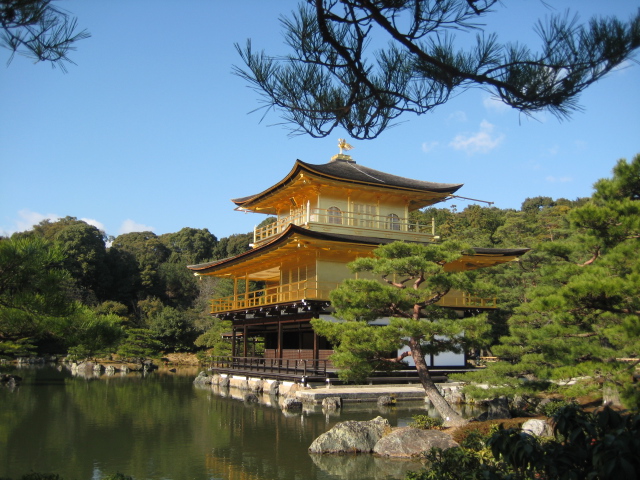
In these examples, the relationship between the physical world and the world of ideas is similar to the Platonic one. The Golden Temple is to the idea of the Golden Temple as the miniature model of the Golden Temple is to the temple itself. In other words, the physical building, no matter how beautiful, is an imperfect reflection of its idea. While Plato himself did not explicitly set the two in conflict, it is not far from here to the conclusion that the destruction of the physical form allows the idea to exist in unsullied purity — perhaps that is why Mizoguchi feels compelled to burn down the temple. But in The Temple of Dawn, the connection between ideas and reality appears to be severed entirely:
(Dawn, 127-128)
Ostensibly, this philosophy is meant to solve the problem of cause and effect, “the question why men who possess no ‘self’ go through samsara… Because if samsara occurs through a sequence of causes and effects — a good cause producing by reward a good effect, a bad cause a bad one — there must be an eternal host substance responsible for causal actions.” (Dawn, 112-113) But if all existence is illusory, as Buddhism requires, then there can be nothing eternal. Cause and effect have to occur in the same instant:
(Dawn, 124)
With this theology in hand, Honda is well-equipped to survive World War II. The destruction of Japan, the end of its independence, the delayed death of its culture, are all easier to bear if one believes that they only ever existed arbitrarily in a single moment. “The vast panorama of devastation before his eyes, resembling the end of the world, was not the end itself, nor was it the beginning. It was a world that imperturbably regenerated itself from instant to instant… Honda felt no emotion as he compared this sight with the city as it had been.” (132) The Yuishiki doctrine in which Honda immerses himself does offer an explanation of cause and effect — there is, after all, a kind of eternal substance, but it takes the form of fragments that exist only in individual instants. But, as Honda’s reaction to the bombed-out ruins of Tokyo clearly shows, this really has the effect of dismantling the continuity between these instants. There may be some connection between the Japan of Spring Snow and the present day, but only in the form of “the vast flow of selflessness of the alaya consciousness.” (123) There was no meaning in it then, and none now, and therefore, it does not really matter whether the connection was ever really there.
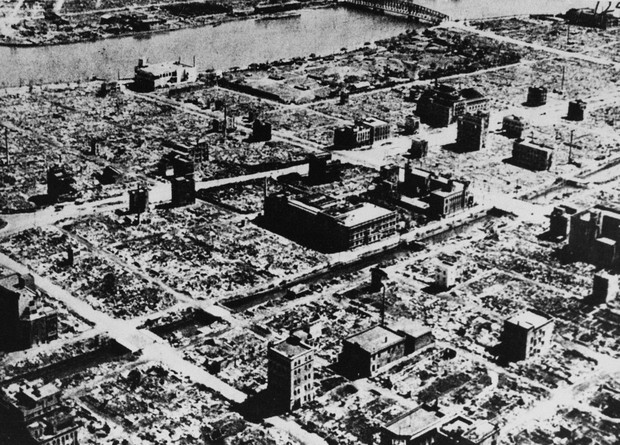
(Dawn, 130-131)
And there is certainly no room for an eternal world of ideas in this vision of the universe. But then, Mishima’s focus here is only on physical existence. Perhaps the world of ideas does exist, but it is somewhere completely outside the chaotic torrent of meaningless matter. Perhaps physical existence is no longer the shadow of true reality, but something else completely disconnected from it. Perhaps the physical world is just as inferior to the ideal world as in Plato, but there is no longer any bridge between them, no vantage point in the first world from which one might glimpse the second. And, since the past does not exist, we have no way of knowing if there ever was.
Again, we are reading all this from Honda’s point of view, and he has always lived separately from human life and feeling, so perhaps the Yuishiki philosophy only applies subjectively. Regardless, it also serves as an apt metaphor for the world of The Temple of Dawn relative to its predecessors. The past has been physically destroyed and the connection to it has been lost, even for people who used to live in it. Without their old roles, their lives lose structure and take on an arbitrary, parodic character — for Honda, who suddenly becomes a millionaire by dumb luck, for Makiko Kito, now finally free to indulge her sadistic tendencies, and really for everyone, in every country and every era, who has the misfortune to live long enough. Honda’s wife, noticing that “the rain has stopped and the evening light was limpid,” looks for Mt. Fuji through the window, but “The postwar sky, unlike that of former days, was bright, but an isinglass cloudiness had settled everywhere. Fuji was not visible.” (259) Presumably this symbol of Japan is still there, but it can no longer be seen. One wants to say “and never will again” — it is all but stated openly, although it cannot be true in the literal sense.
And yet, if the past really is obscured forever, that only means that it has moved to the world of ideas. We may not be able to reach it, but perhaps it can still reach us. From its eternal domain, it somehow continues to wound, if only indirectly, the people who destroyed it:
(Dawn, 195-197)
It will happen exactly like this. The all-powerful masters of the universe will become objects for the sneering contempt of wise foreign prostitutes. Military victories and defeats often turn out to mean surprisingly little in the long term. It is only culture that truly lives, sometimes — often — after death.
But for Honda, the absurdity of post-war life coincides with his own physical decline, which in Mishima, of course, is also morally suspect. Ying Chan appears again, now as a beautiful young woman, and we proceed to the next oddity of The Temple of Dawn, namely, Honda’s love and pursuit of her. She only has a few lines of dialogue in the entire second half of the book; Honda is only able to speak to her once, and thereafter she laughingly eludes him.
Whatever the broader context may be, however this part of the novel may relate to Mishima’s views on the fate of Japan and other subjects, before all else it is the story of an old man’s infatuation — helpless, desperate, and laughable, as they always are. Ying Chan is beautiful. “Her breasts, visible above the level of the table, were, quite unlike her face which was childish, magnificently developed, like those of a figurehead on a ship. He knew without seeing that the body of one of the goddesses in the Ajanta murals lay beneath the simple student’s blouse across from him… She seemed to be just as casually oblivious to the words that her body spoke as she was when she listened to Honda’s recital.” (199) Nonetheless, Honda’s goal is not exactly to possess her physically. He develops a complicated scheme to spy on her naked body, with the goal of ascertaining whether she has the same birthmarks as Kiyoaki and Isao. “If those moles were not to be found on her left side after careful inspection, he would then fall in love with her completely and utterly. Transmigration stood barring the way to his love, and samsara held his passion in check.” (202)
I must say, it has never been very clear to me why this should matter. Ying Chan already proved herself, in the first half of the book, to be Isao’s reincarnation, so there is no uncertainty to dispel. And transmigration has ceased to be an awe-inspiring mystery to Honda; it has become just another mundane fact of life. Perhaps he is somehow yearning for an unexpected break in the pattern, a sign that reincarnation is more than a predictable, mechanical process. But, whatever the reason, his obsession is real enough, as are his regrets, the typical regrets of an old man in this situation. “There are rules more severe in this world than those of morality… Unsuitable lovers were punished by the fact that they would never be the source of dreams, but merely evoke disgust in others.” (201) Honda was never suitable for this role, and certainly not now in his late fifties; the mere notion is ludicrous. He even consciously understands that he is living out a debased parody of Kiyoaki’s doomed love, “the faintest caricature of the noble passion” (184) that he had observed forty years earlier.
truer words (Dawn, 261)
Unfortunately, rational thought is of little help at times like these. A man suddenly realizes that he has wasted his entire life, and longs to feel. And he does, unfortunately, only it’s too late for it to matter — no one will come, no matter how strong or sincere his feelings are. And he knows it. Nature is cruel. The time in a human life during which love is possible, the time for all physical and emotional experience, is exceedingly short, and if you miss it, there will never be another. We die emotionally decades before we die physically. “Why was it that now when his ugliness had become so obvious, the world about him was still beautiful? This was indeed far worse than death itself; the worst death!” (158) Honda’s yearning for some form of experience leads him to the humiliation of voyeurism; his solution to the problem of his own unsuitability is to remove himself from all possible erotic situations. Out of distaste for his own lust, he decides that it would be better not to try to possess Ying Chan: “Long ago Kiyoaki, fascinated by the completely impossible, had committed an impropriety. But Honda created the impossible so that he would commit no violation of it. For the minute he attempted a violation, beauty could no longer exist in this world.” (263) Perhaps that is why he makes so much out of the question of the three moles that may or may not be on her body — as long as it remains unanswered, his love can remain safe in the realm of pure contemplation.
Well, that is very polite of him. Perhaps, in Mishima’s eyes, this was actually something to be criticized, yet more evidence of Honda’s incapacity for real action, or his inability to match Kiyoaki’s strength of feeling. In fact, there is a certain detachment both in Honda’s love and his self-abasement. He shows signs of obsession, but he never abandons rationality, and never crosses the line (at least, not in Dawn) beyond which his dignity would be damaged irreparably. And that suggests that his passion for Ying Chan was never really that strong, which makes this part of the novel feel somewhat half-hearted. You see, there really is such a thing as an old man’s love. It is every bit as laughable as Dawn describes, and even more so, but in intensity it is, unfortunately, more than a match for poor Kiyoaki. An old man’s love is full of self-hatred, a quality that Kiyoaki notably lacked, and burns all the more brightly for it. The more the old man loathes himself, the more deeply, the more passionately, the more sincerely he loves the young woman. He may never reach the point of taking any action. Old men are cautious, not to say cowardly. It may all happen entirely in his mind. That does not make it better. He will lie awake at night weeping at his own inability to act. But action doesn’t help either; he knows that, even if he were to succeed, she still wouldn’t love him, not really. Because the time to be loved ended years ago, back when he wasn’t even aware of it. Mishima wouldn’t have known what this was like; he wasn’t really the type to fall in love. But yes, one might be forgiven for thinking that checking out early may be preferable to such helplessness.
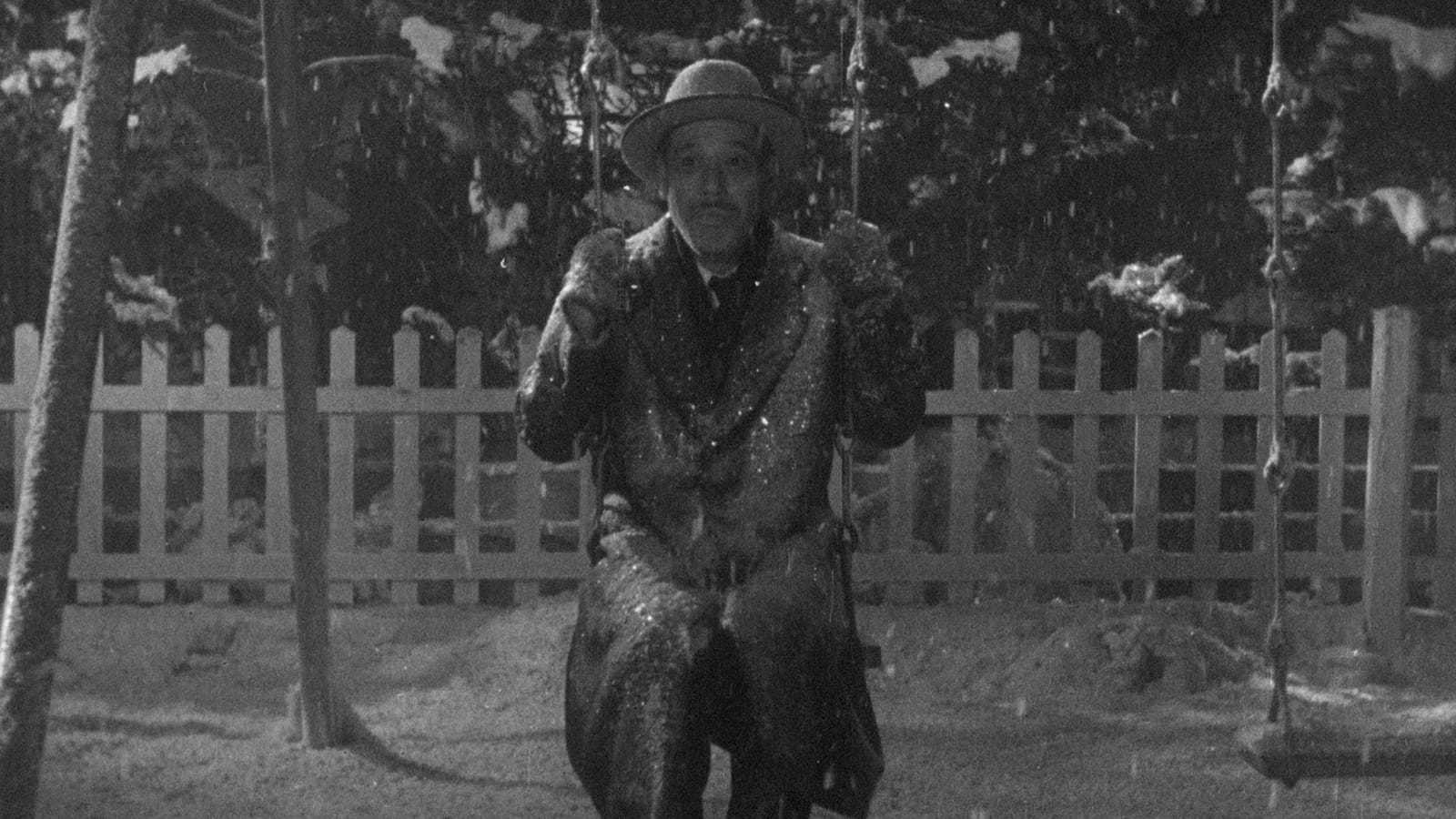 Or not. But it takes a special kind of courage.
Maybe this is what Kurosawa’s Ikiru is really about. The point is not that an old man decides to spend his last days helping others. This only happens after he makes several failed attempts to “enjoy himself.” It quickly becomes clear that restaurants and women do not fit either his advanced age or his lifelong habits as a modest civil servant. He isn’t even able to quietly savor the completely innocuous presence of a young woman — they are just too different, there’s nothing they can talk about, she becomes bored and uneasy, and finally leaves. Only then does he fully devote himself to the playground project. And in his last moments, as he sits on the swing, he sings to himself an old song about the impossibility of recapturing the past — “Life is brief / fall in love, maidens / before the crimson bloom fades from your lips / before the tides of passion cool within you” — written in the Taisho era, when the events of Spring Snow took place.
In any case, Honda’s plan finally succeeds, and he discovers that Ying Chan has an older lover after all, only it’s a woman — Honda’s aggressive, cynical friend Keiko, whom he had ironically tried to recruit earlier to help him in his plan. Rather humorously, spying on them leads him to a reconciliation with his ungracefully aging wife, who takes a turn at the peephole and is relieved to find that Ying Chan isn’t her rival. Ying Chan does have the three moles marking her as Isao’s reincarnation, of course. And that is the last time Honda sees her. Only much later, in 1967, does he learn that she had died shortly after returning to Thailand, having been bitten by a poisonous snake just after her twentieth birthday, in fulfillment of Isao’s dream: “At that moment Isao noticed a little green snake put its head through the railing. What had seemed to be an outstretched vine there suddenly grew longer. The snake was quite thick, like a waxwork figure colored in light and dark shades of green. Its lustrous, artificial-looking body was not a vine, something Isao discovered too late. Its fangs had already found their mark by the time he realized that it had coiled itself to strike at his ankle.” (Runaway Horses, 341)
This is the greatest oddity in The Temple of Dawn. Thus far in The Sea of Fertility, dying at age twenty has been a kind of badge of honor, in recognition of heroic impulses that are so great and so passionate that they render their carriers unable to live normal lives. But Ying Chan shows no signs of love or heroism. In fact, the opposite is the case: “Honda could see the two women entangled beneath his gaze only in their suffering and torture. They were battered by the dissatisfaction of the flesh, their gathered brows were filled with pain, and their hot limbs seemed to writhe as though trying to escape from what seared them. They possessed no wings.” (Dawn, 319) If Kiyoaki and Isao succeeded in tearing through the fabric of reality to some glorious, all-consuming absolute truth, Ying Chan remains trapped on earth. In The Decay of the Angel, the same Keiko speculates that “Ying Chan’s spirit was in the shining beauty of her flesh.” (The Decay of the Angel, 205) Perhaps that’s all it ever was, and she had to die young simply because she was too beautiful to live. But we’ve already seen in Spring Snow that physical beauty, in and of itself, is an unsatisfactory ideal, and that it has to be destroyed before “true beauty” can emerge. True beauty, as far as anyone can tell, is not something that Ying Chan ever possessed. Although there is no way of knowing — she barely has any spoken lines. And she did have the unique distinction of remembering her previous incarnation.
But perhaps the blame lies, not with Ying Chan, but with the universe. The world itself has changed. Something was lost in that instant where it was destroyed and remade, and that alone proves that there had once been something to lose. The new world makes it impossible for young people to experience that kind of dazzling, magnificent sublimity. No Kiyoaki or Isao could ever appear in it. And their reincarnation has to live by the new rules, within the narrower, more restrictive bounds of reality. “They continued their futile thrashings to escape from their bonds, from their suffering; and yet their flesh firmly retained them.” (Dawn, 319)
In that connection, there is an odd aside earlier in the novel that maybe means more than seems at first. Walking around aimlessly, Honda visits a bookstore, and the following happens:
(Dawn, 224-225)
Well, leave it to the master to think of some suitable perversion to represent the post-war decay of the national spirit. It is all the more unpleasant because it is, unfortunately, totally believable. But perhaps lack of spirit is not the problem. “Sexuality that storms day and night like a gale through the metropolis. A great dark overabundance. The streets across which shoot the flames of Molotov cocktails. The great underground canal of hidden sexual passion.” (226) Who knows? This might be the Kiyoaki of his generation — he is the right age for it. It is just that this great, dark, brutal instinct can find expression only through the tawdry, commercial, and dehumanizing. Even a pure impulse will be deformed, misshapen.
According to Mishima (or Honda, if you wish), the youth commits this act of exhibitionism not only out of fear of loneliness, but also because he fears hurting the woman somehow. Doing this in public brings him down to her level and makes him her equal. But from there, it is only a short distance, which Mishima stops just short of crossing, to seeing this as an act of compassion. He isn’t able to see her solely as an object, try as he might. He can’t resist using her for his gratification, but he also feels her suffering. And so, he wants to make himself suffer with her, to undergo his own version of her humiliation in the only way available. You know…not once anywhere in Spring Snow did Kiyoaki ever feel that much compassion for Satoko, not even at the end. It may be ugly as hell, but it is a form of love. There just isn’t any place left for any other form.

(Conclusion: part 4.)
 Fallen Leaves