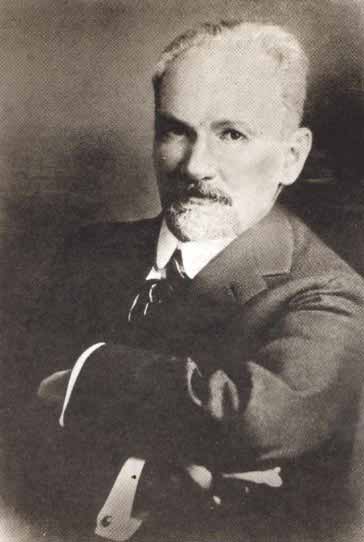
Rozanov belongs at the end. Leontiev’s seeming contradictions ultimately resolved into a simple and organic whole, and his beliefs and opinions remained consistent across twenty years of writing. Rozanov is notorious for ideological inconsistency. In Fallen Leaves, he described his credo as, “To mix together all political ideas… To change ‘red to yellow,’ ‘white to green,’ to ‘break all the eggs and fry them’… To extinguish the flames of politics by making ‘no one understand anything,’ seeing everything as ‘mixed up’ and ‘confused’…” (Rozanov, XXX/200-201)
Wikipedia groups him with Leontiev, Dostoyevsky, and Metr. Tikhon (Shevkunov) under “Russian conservatism.” Indeed, Leontiev was an early influence, and when Rozanov first began to publish essays in the 1890s, it was under the patronage of conservative critic Nikolai Strakhov, Orthodox philanthropist Sergei Rachinsky, and, later, newspaperman Alexei Suvorin, whom Nabokov slandered fifty years later in Other Shores as “the somewhat less disreputable editor” of “the most powerful of the Rightist newspapers[.]” But Rozanov did not stay in the Slavophile camp for long. By the mid-1900s, he was associating with decadent writers such as Dmitry Merezhkovsky and writing extensively from anti-clerical positions. In the 1910s, he broke with that side too, rather acrimoniously — Merezhkovsky publicly demanded his expulsion from the Society for Religious Philosophy. At the same time, Rozanov never fully abandoned any position, continuing to publish in Suvorin’s New Times concurrently with the decadent magazine World of Art, the nationalist broadsheet The Bell and other outlets, often under pseudonyms (many of his articles were signed “Varvarin,” “Vetlugin,” “Yeletsky,” etc.). He made little effort to justify these seeming ideological about-faces to his readers; the closest thing to an explanation is perhaps the following entry in Fallen Leaves:
(Rozanov, XXX/254-255)
Perhaps this was not entirely on the level. Rozanov’s biographer Alexei Varlamov suggests that Rozanov left the Slavophiles simply because he would never have had enough room to grow if he had stayed: “As a conservative, as an Orthodox Slavophile, as he was when he first arrived in St. Petersburg from the provinces, [Rozanov] was not of any particular interest to anyone. Yes, he was cocky, he was brighter, more talented and more radical than others, he had acquired a certain reputation, but then what? But Rozanov the pagan, Rozanov the anti-Christian, Rozanov the Egyptian, Rozanov with the theme of sex…that was a different matter. His opinions, his attacks seemed new, sharp, unexpected, and most of all, highly modern and of great interest to the public.” (Varlamov, 136) In other words, his conservative allies expected him to remain in the rank and file and fight the good fight alongside them, while he, having lived by then for a decade in obscurity as a provincial high school teacher, hungered for an audience. But of course, careerism alone also explains nothing; if that was what Rozanov wanted, the winning move would have been to throw in with Merezhkovsky and Berdyayev, both of whom had a comfortable life in exile post-Revolution while Rozanov starved to death in 1919.
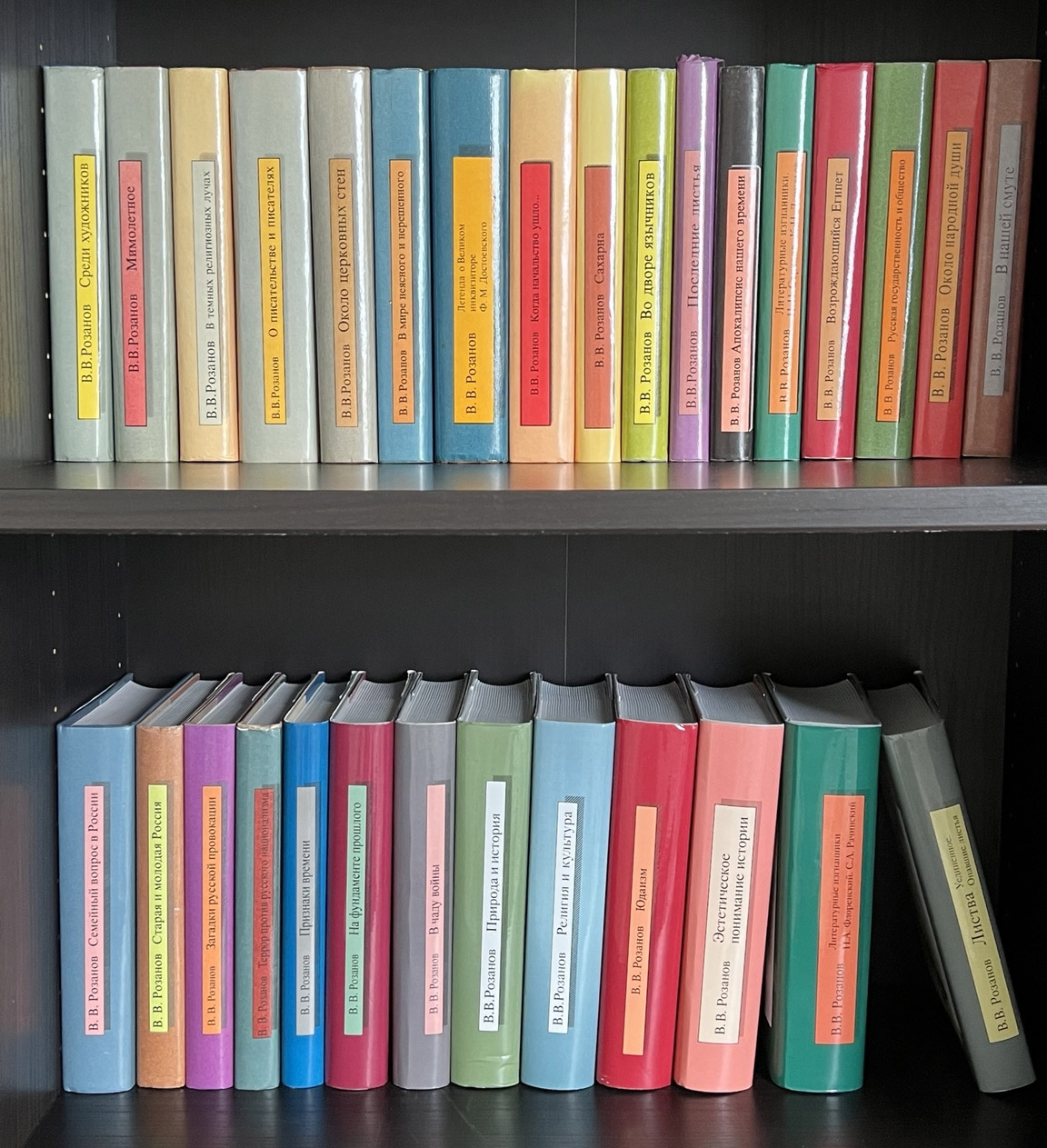
Thus, by the time Rozanov’s definitive work began to appear, beginning with Solitude in 1912, he had already built up a reputation as a controversial, sometimes scandalous publicist. His academic collected works comprise 30 volumes, with the first published in 1994 (none of his books was ever printed in the Soviet Union), and the last only in 2010. Nearly all of this material consists of essays and newspaper or magazine articles, rescued from oblivion in library archives and rough drafts. Only vols. XII (Apocalypse Of Our Time) and XXX (Leaves) are devoted to the writing that earned Rozanov a permanent place in Russian literature.
opening lines of Solitude (XXX/7)
In Solitude, the fragmented, eclectic nature of Rozanov’s literary, philosophical, and ideological interests turned into a new literary form. This short book is a sequence of unrelated, impressionistic entries, whose length ranges from a single line to several pages. It is not fiction, but it is not exactly nonfiction either. At the time, it did not resemble any accepted form; it has the most likeness to a diary, except the entries are only occasionally dated, and not necessarily arranged in chronological order. Kierkegaard’s “Diapsalmata” might be a distant relative. Contemporary readers would recognize it as being oddly similar to a blog. A single entry may begin with literary commentary, proceed to self-reflection, pause for an autobiographical anecdote, and ascend to a philosophical conclusion:
(Rozanov, XXX/43-44)
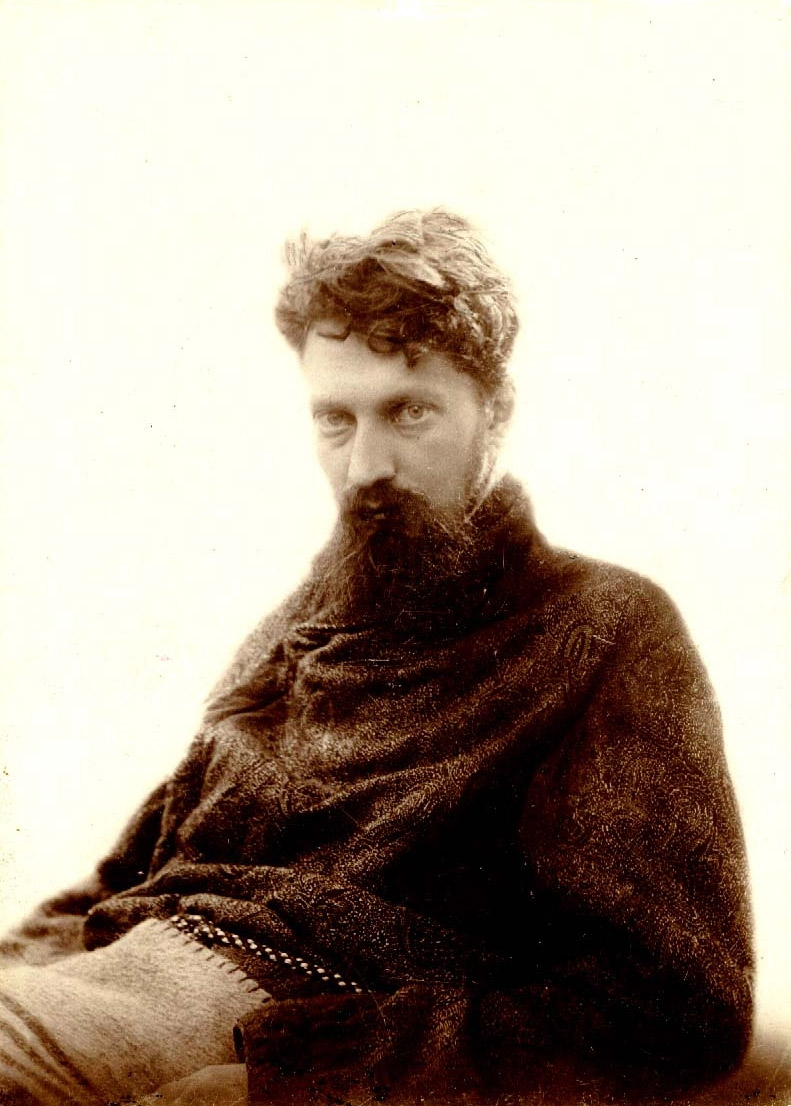 Fyodor Schperck, younger acquaintance of Rozanov,
“a boy of 26 years when he died, never having expressed himself.”
(Rozanov, XXX/56)
The thought ends here. The next entry has a completely unrelated subject (Rozanov’s reaction to an article in some long-forgotten liberal newspaper). No entry in Solitude reaches the level of development one would expect from an essay, even a purely autobiographical one. That same fragmentary quality gives Rozanov’s reflections the appearance of piercing sincerity. Or, perhaps, sincerity in the moment, which, by his own admission, is all that he ever valued.
Just to illustrate some of the directions in which Solitude goes, here is one more fragment:
(Rozanov, XXX/14-15)
As an opinion piece, as a historical excursion, as sociology, as ethics, as philosophy finally, this is all utterly bizarre. But something elusive in it is true. At least, our age is in the worst position to deny it, having commodified and professionalized not only physical intimacy (that is at least no different from the rest of human history) but also non-sexual touch, compassion, attention, advice, friendship, and every other imaginable form of contact between human beings. And there is a certain logic to it — these “goods” are something that everyone needs, but for an increasing number of us the “emotional labor” (as it is now called) involved becomes so great and so thankless that there really seems to be no solution other than compensation. Or perhaps a better way of saying it would be that what we demand is so total that no other person would ever be able to provide it “freely,” and so the “market” is the only place where even a weak semblance of it can be found. Not only is there a “public” sale of the self buried deep in many social roles (as anyone who has ever interacted with “the professorate” knows), it has also expanded to formerly private areas of life. The all-consuming nature of it actually suggests that it is in fact not a malady of Rozanov’s time or ours, but rather an expression of some deep element within “sociality,” or really within humanity itself. Which is also supported by the fact that these roles are not only artificial — “tenderness for all” is just as important in Rozanov’s phrase as “indifference.” Sometimes that kind of “tenderness” is the most real precisely because of its greater scale. It has the same sincerity as the philosopher who simultaneously contemplates every possible side of every question.
It is not coincidental that one of Rozanov’s examples in this passage depicts a priest, equally ready for any service, equally open (within the boundaries of his position) to every human joy or sorrow, no matter whose they are. It may be offensive, most of all to the person requesting the service, to think of the priest’s role in this way. But Rozanov does not use these words pejoratively. Perhaps the most frequently recurring theme in all of his writing is the conflict between (and his conflation of) holiness and worldly eroticism. Doubtless this is what endeared him most to Merezhkovsky and the decadents, who were pursuing a simple anti-clerical program — the Society for Religious Philosophy was, from the beginning, neither religious nor particularly philosophical, and while some liberal clergy were involved in it as token “Orthodox” representatives, its overall program was to dilute religious teaching with elements of occult spirituality, in a manner that will be instantly familiar to anyone who has read Orthodoxy and the Religion of the Future. But it is also clear why Rozanov never fit comfortably into that program. The main difficulty was that he believed in God.
(Rozanov, XXX/34)
Well, that might still have been borderline acceptable to the advocates of vague “spirituality.” But Rozanov added, “The soul of Orthodoxy is in the gift of prayer. Its body is in ritual and observance. But anyone who thought that it contained nothing beyond ritual…no matter how intelligent, he would have understood nothing about it.” And then, in the very next entry: “Whoever loves the Russian people cannot fail to love the church. Because the people and the church are one. And only for the Russian people are they one.” (XXX/56) These statements may seem standard and expected coming from a “conservative thinker,” but it was not easy for Rozanov to make them — “anyone…no matter how intelligent” may well be a reference to himself. By 1912, he had built up a history that made them very unexpected.
I will now look more closely at Rozanov’s anti-Christian writing. A strange topic for Easter Sunday, perhaps. But first, I wish to show what it really costs someone to finally be able to write, “And I rushed back (at the end of 1911) to the Church: the only thing in the world that is warm, the last warmth in the world…” (XXX/65) And second, the entire conflict is an illustration of a much more general tendency. Rozanov was hardly free from the ideological blinders of his time; in a way, his writing is the culmination, the ultimate end of every intellectual thought and fashion of the late 19th century. Throughout much of this, it is the century itself that speaks through him.
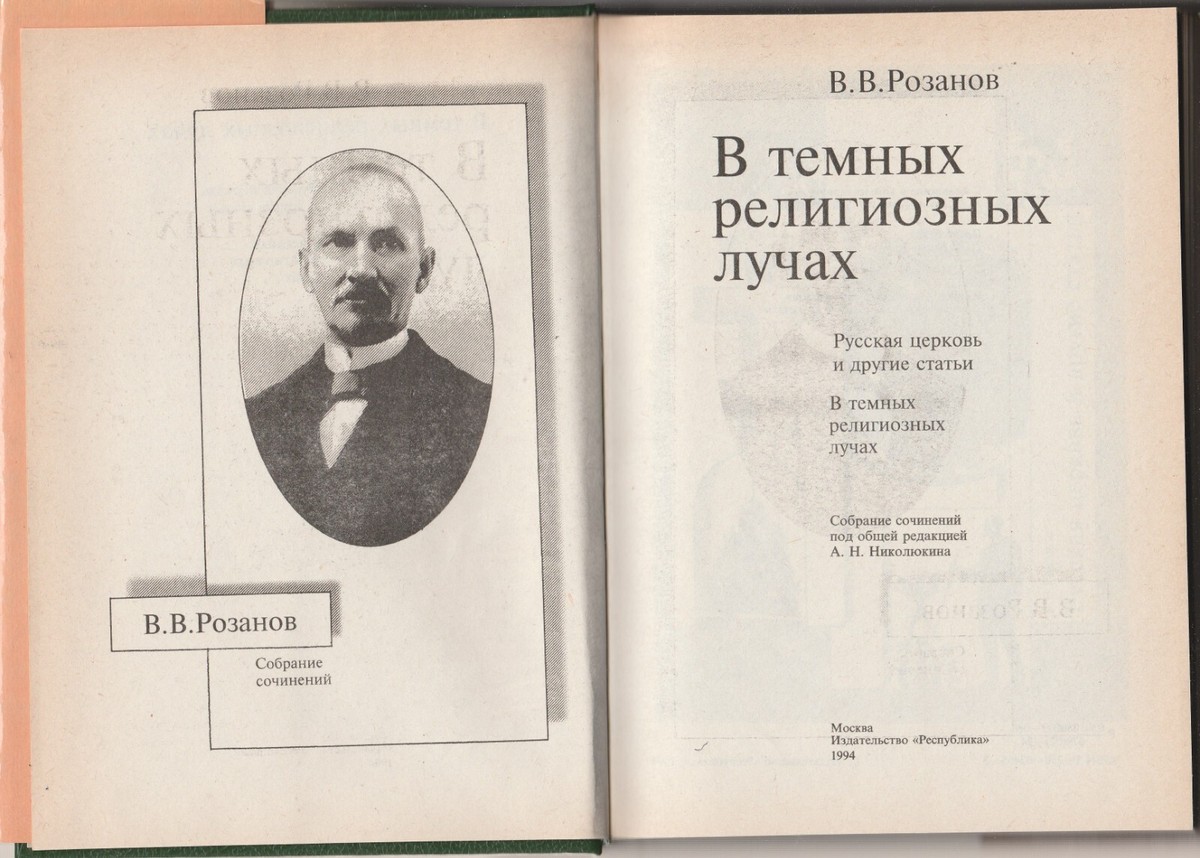 In the Dark Rays of Religion, vol. III of the collected works.
Published in its original form in 1994 for the first time.
In fact, Rozanov’s most vehement anti-clerical book, titled In the Dark Rays of Religion, contains less Rozanov than one might expect. It is less original, in a literary sense, than Solitude, but it still has an unusual form for a polemical work. Part of it gathers together a handful of essays that had already been published in various places. Part of it (mainly toward the end) presents new or reworked material; one essay is an extended version of a speech that Rozanov made at a meeting of the Society for Religious Philosophy. The entire midsection, comprising about a third of the length, is not written by Rozanov at all. Rather, it consists of letters he received, newspaper clippings with his brief commentary, excerpts from various books and articles, and most strikingly, a case study of a fringe suicide cult from a small village near present-day Tiraspol. This oddity is notable for having been written by Ivan Sikorsky, doctor of psychology and father of the 20th-century aviation pioneer. Rozanov reproduces this text in its entirety or close to it, adding only notes in the margin, many of them quite uninformative. Some of his footnotes have a Leninesque inarticulate intensity: “There! There! There!” (III/247)
This eclectic collection had already been printed in 1910 when it was banned by court order, and the entire run of 2400 copies was destroyed. Nonetheless, Rozanov published most of it anyway in 1911-1912 after some light edits. This peculiar combination of power and powerlessness was typical of late-period European monarchies — Church authorities were still strong enough to try to block anti-Christian writing, but not strong enough for the attempt to succeed.
In this case, the attempt was misguided, if only because In the Dark Rays is absolutely helpless as polemic. The Sikorsky pamphlet, positioned exactly in the middle of the book, exemplifies everything that is wrong with it. In brief, it describes events that transpired in the late 1890s in a small community of Old Believers of the more radical “priestless” type, which purports to follow pure Orthodox traditions from before the 17th century, and rejects all Church hierarchy entirely, including any parallel schismatic version of it. The small group in question, having already lived in isolation from the outside world for some time, interpreted the government census of 1897 as a sign of the coming end of the world, and resolved to commit suicide together by being buried alive. The driving force behind the death pact was a self-styled “nun” known only as Vitalia, “a maid of 35-40 years distinguished by energy and great resolve” who appeared in the community one day and eventually “took into her hands the management of all affairs and the internal life of the skete.” (III/197) Twenty-five people, including Vitalia herself, died before anyone on the outside learned of what was happening. One of the survivors, Fyodor Kovalev, who served as gravedigger, gave a detailed account of the events to Sikorsky, who formed a positive impression of him as “a kind man, given to quiet sorrow and sad contemplation” who had fallen under “the powerful influence of another personality and assimilated so much of its moral ethos and character as to change even the primary features of his face.” (III/235)
Again, a familiar tale to anyone who has read Fr. Seraphim (Rose). The epilogue of Orthodoxy and the Religion of the Future discusses Jonestown, and throughout Fr. Seraphim’s book there are many examples of cults that use Christian terminology and symbolism. He would not have been surprised to hear that there was an “Orthodox” version of it too. To a neutral reader, if Sikorsky’s report demonstrates anything, it is the importance of organized religion, in which the presence of a greater hierarchy imposes some limits (even if they are not always sufficient) on any one person’s ability to claim total spiritual authority. Rozanov even highlights Vitalia’s role in the tragedy as an example of how “every time that women have the upper hand in a mixed crowd of people, they always bend religion in the direction of cruelty and self-flagellation.” (III/201) Even if one accepts the veracity of that statement (because there is no point in arguing with Rozanov about anything), this would seem to be an argument in favor of the “official,” all-male Church hierarchy. But he doesn’t see it that way. His thesis here is that Vitalia’s cult is actually the truest expression, not only of Orthodoxy, but of all forms of Christianity:
(Rozanov, III/190)
Whether Christianity is the only religion with suicidal sects, or whether “fanatical” Christians also have the capacity to devote their lives to “compassion and helping one’s neighbor,” are questions best left for freshman dorm rooms. A few pages later, however, Rozanov describes Vitalia’s group as “simply people of the monastery and of monastic spirit, only fiery and consumed, unlike the lukewarm ‘Orthodox’ of the official church.” (III/194) In other words, the argument is that the fanatics of any religion represent its purest essence, i.e., “fire” is the sign of any true faith. Well, it is a tempting argument, and even flattering to a certain type of religious mind, but upon reflection, I don’t think it can really withstand criticism. “Fire” is an individual impulse, a form of personal judgment, an intuition. The fanatic may refer to spiritual texts in search of support, but the search is spurred by the intuitive impulse and therefore always one-sided. Organized religion, on the other hand, is distrustful of individual impulse already when it asserts that God exists externally, that is, independently of human experience. The believer must subordinate his own personal intuition to God’s will, and must accept the expression of His will through concrete structures that also exist externally: texts, rituals, laws, traditions, hierarchies. Nothing is concrete about “fire.” Intuition can appear from anywhere, and Orthodox Christianity in particular adamantly insists that it can be maliciously suggested to the individual from the outside. Rozanov repeatedly wrings his hands whenever Sikorsky mentions that the sectarians had religious books: “There! The books hold the answer! And even after this frightful death, the clergy couldn’t feel enough obligation of conscience to prove that it has no ‘books’ that imperceptibly and gradually…led these people to such a fate?” (III/209) But, evidently, whatever books these were did not include The Ladder of Divine Ascent, which repeatedly admonishes those given to excessive “fiery” fervor: “Once the demon of pride has established himself in his servants, he comes to them in dreams or in wakefulness, in the guise of an Angel of light or a martyr, and claims to teach them revelations and mysteries, and what appears to be the gift of gifts, so that these accursed, having been enticed, lose their minds completely.” These lines, written in the 7th century, describe every fanatical sect that ever existed — and it is noteworthy that the demonic temptation described by St. John Climacus takes on an overtly Christian appearance…
But even that is the wrong way to go about it — there is no use trying to fairly engage with an argument that is so unscrupulous as to blame the Church hierarchy for the actions of a group that was in open rebellion against that hierarchy. The truly fatal problem with In the Dark Rays is not some weakness of logic or rhetoric that requires careful analysis. The problem is more fundamental and goes beyond Rozanov. To demonstrate it, we may look at his collection of newspaper clippings. One of them states: “Gregory of Nazianzus wrote to blessed Jerome: ‘We need more fables to impress the crowds. The less they understand, the more amazed they are. Our fathers and teachers did not always say what they thought, but rather what circumstance and necessity placed in their mouths.’” In the footnotes, Rozanov gloats, “it is evident that not only [the saints], but according to them, also the ‘holy’ churches that came before them, consciously lied in order to deceive the people.” (Rozanov, III/171)
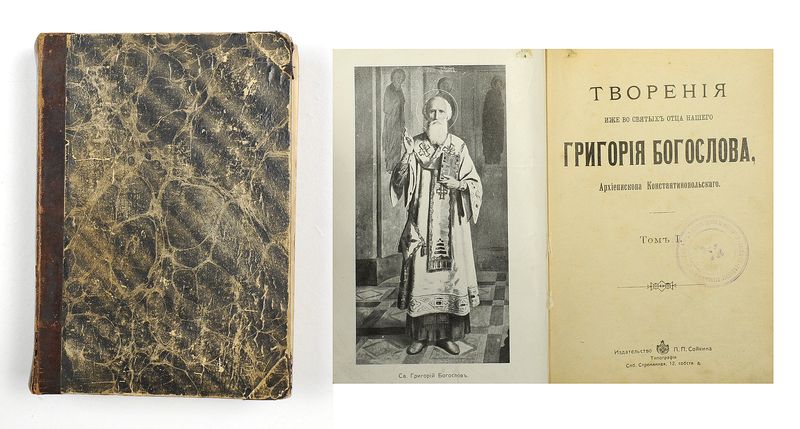 1912 edition of St. Gregory’s collected works.
But now we don’t need to hunt for it; everything is digitized.
Unfortunately for his argument, however, this quote is fabricated. The entire corpus of St. Gregory’s letters is well-documented. In total, there are 249 letters that have historically been attributed to him, of which 230-240 are believed to be genuine (depending on whom you ask). In our digital age, it is easy to check them and verify that he never wrote any such thing, whether to St. Jerome or anyone else. In fact, he never wrote to St. Jerome at all. You will not find this quote in either the most recent Western academic compilation on the subject (Gregory of Nazianzus’ Letter Collection, University of California Press, 2019) or in any traditional Orthodox collection (e.g., The Works of Our Holy Father Gregory the Theologian, printed in 1912 in St. Petersburg).
Then where did Rozanov find it? Previously, we saw that his memory for quotes was unreliable, as when he attempted to recall Leontiev’s Oriental stories. But, nonetheless, his invention still had basis in Leontiev’s real text. As tendentious as In the Dark Rays may be, Rozanov would not have stooped as low as forgery. In fact, he cites a source, the magazine Moscow Weekly, though he only vaguely names the year without issue or page numbers. Unfortunately, the archives from 1906 are not digitized, but in fact, the quote does have a source. It is none other than occultist adventuress Helena Blavatsky, the 19th century’s Alan Watts. The precise wording (she originally wrote in English) is: “This is what Saint Gregory of Nazianzen wrote to his friend and confidant Saint Jerome: ‘Nothing can impose better on a people than verbiage; the less they understand the more they admire. Our fathers and doctors have often said, not what they thought, but what circumstances and necessity forced them to.’” The slight differences from Rozanov’s version can be attributed to translation or Rozanov’s usual inaccurate recollection.
Blavatsky, of course, gave no source for the quote, because none existed. However, it does have a distant prototype in reality, and it is instructive to look at that as well. One of St. Jerome’s letters, not to St. Gregory but to a certain Nepotian, a young priest of St. Jerome’s acquaintance, contains the following passage:
from Letter #52
In other words, the first sentence of the passage is nearly identical in meaning to Blavatsky’s fabrication, but the overall intention is precisely the opposite. St. Jerome is criticizing the use of rhetoric to impress the “uneducated congregation,” and his actual advice to Nepotian is, “When teaching in church seek to call forth not plaudits but groans… To mouth your words and by your quickness of utterance astonish the unlettered crowd is a mark of ignorance.” Blavatsky simply inverted it, and replaced Nepotian by the much more historically significant St. Gregory to add an extra air of authority.
Rozanov then became an unwitting dupe. I doubt that he knew any of this; most likely it had never occurred to him to trace the quote back to the source. He may not even have known that it originated from Blavatsky. He did know her name, which circulated among intellectuals with decadent or mystical interests, but there is no indication that he ever had much interest in her specifically. But when he came across this quote in the magazine, it may not even have cited her at all. The fabrication had already entered the discourse and was being repeated in the echo chamber as if it were a well-known fact.
The intellectual environment in which Rozanov lived and worked had absolute, unquestioning credulity in the printed word. Perhaps some skepticism was possible when it came to contemporary political subjects. One could understand that the truth could be stretched or misrepresented in narrowly polemical writing, especially when one’s ideological adversaries were involved. But when it came to more abstract, scholarly topics, such as history and philosophy, the hapless 19th-century intellectual would never have imagined that arguments and evidence could be maliciously invented, and far more easily (because of the greater difficulty of verifying them) than for present-day matters. For some time, Blavatsky was taken seriously as an Egyptologist, or at least as someone with professional knowledge of primary sources. But one shouldn’t forget that many, if not all, 19th-century idols were just more professional versions of the same thing. Marx couched ideology in “scientific” language; so did Hegel. And in any case, their adepts across Europe were in no position to evaluate the merits of their arguments. 19th-century positivism was a kind of obedience school, designed to train the educated class to uncritically accept any kind of irrational ideology, as long as it came dressed up in scientific trappings.
Leontiev argued, in one of his earliest essays (“Literacy and nationality”), that the illiteracy of the Russian peasantry was a net benefit for Russian society: “What we need is for the educated part of the Russian people…to begin enlightening the uneducated part only after it (i.e., the educated part) has itself become more mature. Compulsory literacy can yield good results only when our landowners, civil servants, teachers, i.e., people of Anglo-French education, all become much more Slavophilic[.]” (Leontiev, 73) Putting aside Leontiev’s gleeful contrarianism, his real argument was that the “educated part” of society is in no condition to “enlighten” anyone. The literacy of the intellectual class, and the easy availability of printed and translated books, only served to make them defenseless against the most crude ideological manipulation. Rozanov is the proof here: a porous, excitable mind, educated to a degree unfathomable to most of us now (in his early thirties, he undertook a translation of Aristotle’s Metaphysics from the original), infinitely receptive to ideas and information of all sorts, is nonetheless deceived by a clumsy, rudimentary fabrication. And he wasn’t alone. In the Dark Rays isn’t any less well-argued than Nietzsche or Schopenhauer; in some respects it may even be better. These people were just all like this, everywhere. Revolution and world war were inevitable.
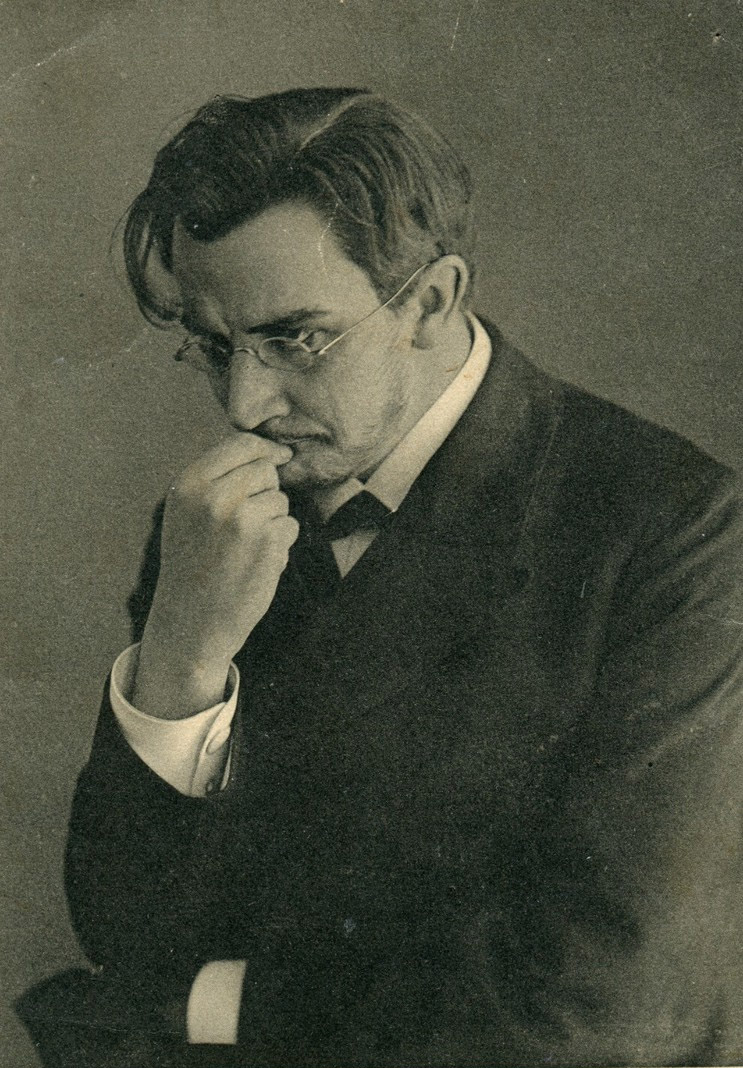 Theatre actor Vasily Kachalov, in the role of Ivan Karamazov.
In The Brothers Karamazov, there is a famous scene where Ivan lays out his anti-theist (or perhaps “God-defying” would be a better word) views to Alyosha. It culminates in Ivan’s “Legend of the Grand Inquisitor,” which also impressed Rozanov — one of his earlier published essays, in 1891, was a detailed critical examination of this chapter as a stand-alone work. But before the “Legend” begins, Ivan makes the following speech:
from The Brothers Karamazov (Book 5, Chapter IV)
The crucial detail, however, is that all of Ivan’s knowledge of these horrors is secondhand. He read about them in newspapers. He even makes a point of it: “You see, I am fond of collecting certain facts, and, would you believe, I even copy anecdotes of a certain sort from newspapers and books, and I’ve already got a fine collection.” In the 1891 essay, Rozanov (who had, at that time, not yet begun his own “rebellion”) describes him as having “a great heart, and a great mind, and all the sadness that such a soul cannot help but carry within itself. Sorrow follows from strength of love and also from heightened consciousness, which is inseparable from it and yet contradicts it.” (Rozanov, VII/50) Unfortunately, saying this only revealed his own naïveté. Compassion for suffering children does not enter into Ivan’s motives in the slightest. He is savoring these tortures (if they had ever happened — there’s no reason why they couldn’t have, but journalistic accuracy did not exist as a concept at the time), using them to whip himself into an emotional frenzy, repeatedly, over and over. They enable his self-excitation, stimulate the pleasures of indignation on demand, and soothe his wounded pride, the vanity of the newly made intellectual whose actual place in society is far below where he fancies himself. There is no point in trying to extract some sort of principled stance from anything he says here. And the print culture of the time is all too happy to give him what he wants. In fact, that is the reason why it exists.
Rozanov unwittingly reenacted Ivan’s paroxysm throughout In the Dark Rays. The ghoulish story of the sectarians burying each other alive gives him the same fuel that Ivan got from his own “collection.” There is a clear sense, if not of pleasure, then of unhealthy fixation, in his repeated harangues: “One sacrifices her father, another her sister! Moloch! Moloch! The Moloch of castration, the Moloch of monasticism! And it all started with something as trifling as ‘let us limit ourselves in food and drink, because it is pleasing to God,’ ‘let us limit ourselves to one wife, because it is pleasing to God,’ and in general ‘let us limit,’ because here was a God of limitations and diminutions, a God of descending reductions [of life]. What can be less than the grave: well, that’s where they flung themselves in the end.” (III/207) It’s not that it was “wrong” to question Christianity or to criticize organized religion; it’s that the people who took this task upon themselves were little more than children. And it wasn’t even their fault: you who are reading this now would have fared no better in their place. They were groping about in total darkness.
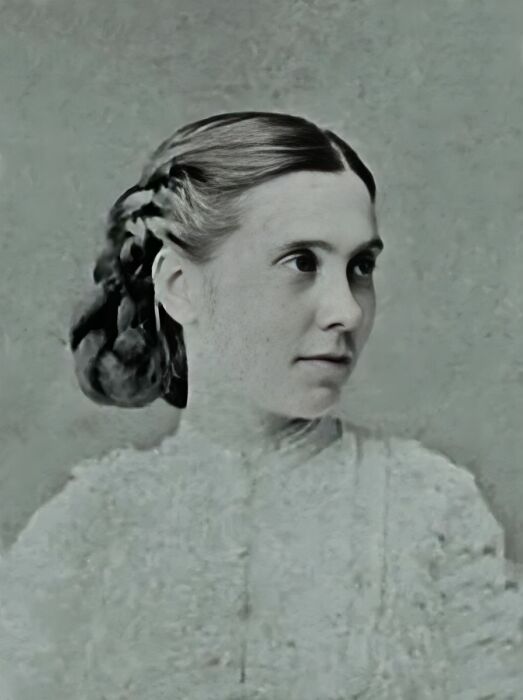 A. Suslova in 1867, long before meeting Rozanov.
Rozanov’s crusade against the Church was personally motivated, hardly a surprise considering the irrational intensity of the fury spilling from the pages of In the Dark Rays. In 1880, at the age of 24, still a student, he married Apollinaria Suslova, 40 at the time, who had been Dostoyevsky’s mistress 15 years prior and likely inspired some of his female characters, perhaps including Shatov’s wife in Demons. In 1916, Rozanov wrote a letter to an acquaintance which included some memories of her: “With the sharp eye of an ‘experienced coquette’ she understood that she had ‘bruised’ me, and spoke coldly, calmly. In a word, she was all ‘Catherine de Medici.’ In fact Kate Medici and she were alike. She would have indifferently committed a crime, killed — all too indifferently, ‘fired at the Huguenots from the window’ during St. Bartholomew’s Day [Massacre] — with great enthusiasm…[she] really was magnificent, and I know that people…were ‘absolutely taken with her’ — imprisoned by her.” We, with the benefit of an additional 150 years of experience, would immediately recognize this as a “red flag.” The marriage was unhappy and emotionally abusive, possibly on both sides. “She was very glad that she did not have children. (‘Where would I go with my children, when my husband is such a scoundrel and failure.’)” By 1887, they had separated and Rozanov had moved, alone, to another town. But when he fell in love with a young widow named Varvara Butyagina and decided to marry again, Suslova did not agree to a divorce. The laws governing marriage at the time were still in the purview of the Church, and so the six children that Rozanov had with Butyagina were viewed as illegitimate and were not allowed to take their father’s surname until after 1905.
Well, it figures. The destroyer of worlds, the overthrower of foundations, the almighty freethinker turns out to be an emotionally messy, maladapted young man who falls in love with the first woman who makes eye contact. He then spends his formative years in abject misery, cannot fully extricate himself for decades, and blames “religion” for it. But it is too vulgar to reduce Rozanov’s rebellion to simple biographical cause and effect. First, whatever his weaknesses may have been, he was a serious and original thinker, which elevates even his errors to some extent; and second, the personal aspect is, if anything, the strongest part of his anti-ecclesiastical case. Separation of Church and state is actually more beneficial for the Church than for the state — it prevents the blurring of spiritual and worldly motives and reduces the very temptation that Ivan’s Grand Inquisitor was unable to resist. If the Church does not dictate marriage law, we might discuss whether it is better or worse for those getting married and divorced, but for the Church itself it is better. In Rozanov’s time, the Church found itself in an untenable position of weakness. On one hand, it still wielded enough of a blunt instrument to thwart the publication of some hostile texts. But, on the other hand, virtually all printed texts of the time were hostile, because 19th-century print culture itself was hostile to the Church. This made it inevitable that the victories would be few and far between, and in the long run would only hasten the defeats — precisely the same trajectory that Leontiev had intuited in the history of 19th-century nationalism.
Rozanov placed family above all things, so it stands to reason that both his rebellion against Christianity and his return to it arose from family matters. In 1910, his second wife became seriously ill. What he described in his later writing resembles a stroke, with ensuing partial paralysis. And, since everything that went through his mind at the time went into Solitude, this did as well:
(Rozanov, XXX/66)
(Rozanov, XXX/69)
(Rozanov, XXX/69)
(Rozanov, XXX/71)
In fact, the illness seems to have occurred while Rozanov was in the middle of writing Solitude. The first half of the book is more in line with his previous decadent preoccupations, though already moving away from the anger of In the Dark Rays. The last pages are hushed and penitent. This tone carries over into Fallen Leaves. To his readers 100 years later, it defines him; it sounds like deep, long-standing conviction. In reality, it was the result of a painful moral struggle taking place at that very moment.
Rozanov’s liberal views are best refuted by Rozanov himself. Here he is in a 1906 essay titled “The Russian Church,” a precursor of In the Dark Rays, expressing the self-satisfied adulation of Tolstoy that was absolutely typical of the Russian educated class:
an A for effort (Rozanov, III/23)
But here he is in the first volume of Fallen Leaves, recalling a visit to a bookstore that was selling postcards of Tolstoy:
(Rozanov, XXX/110)
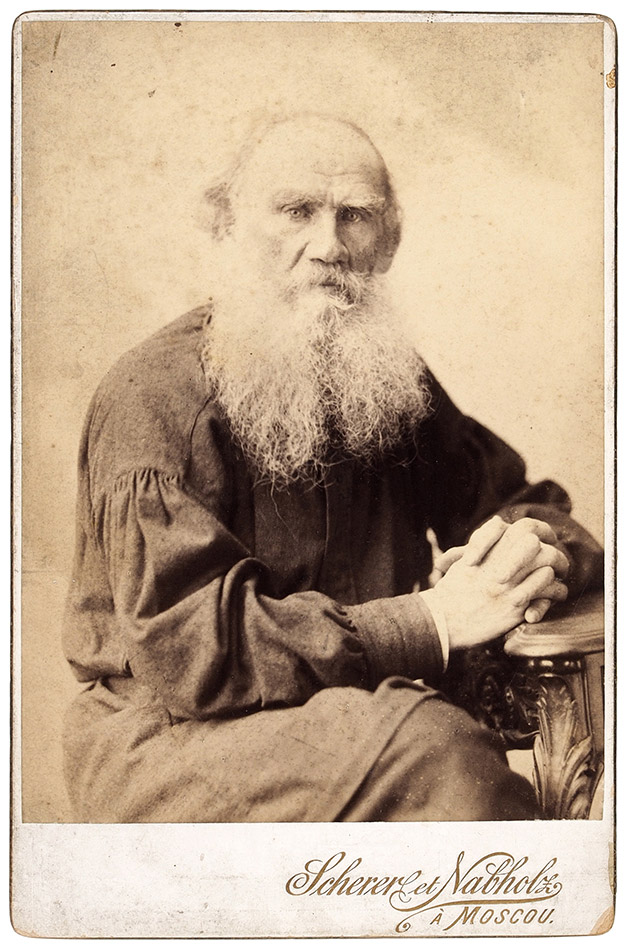 Something like this, perhaps.
Scherer & Nabholz was a professional photo studio.
Even the references to Buddha and Schopenhauer appear again. But it is the second comment, tossed off with irony, that captures Tolstoy’s essence. He was, perhaps, the first real celebrity, the prototype of the various gurus and self-proclaimed spiritual authorities that proliferated in the 1960s. He never quite became a religious leader, the way he likely saw himself, but he had no shortage of secular fame. You have to remember that, in the 1900s, he was famous not for War and Peace and Anna Karenina, but for the much weaker (but fashionably anti-clerical) Resurrection as well as for his “teachings,” which defined themselves in terms of their differences from Christianity and in so doing already made themselves secondary to it. Whereas Rozanov, in less than ten years, had made a generation’s worth of intellectual progress, going from the superficial newspaper-level characterization of Tolstoy as “high, pure, sincere, thorough” (because 19th-century liberal heroes must be secular saints) to a deeper, sadder, and more complete understanding.
I could go on. On the pages of In the Dark Rays, Rozanov rages against fasting and monastic robes, seeing in them a willful denial of existence:
(Rozanov, III/195)
(Rozanov, III/221)
But then, later, in Solitude:
(Rozanov, XXX/59)
This aphoristic statement is actually much more layered than simply marking a change of mind about monasteries. In fact, Rozanov never did change his mind on that point: he was always unsettled and repelled by any kind of asceticism, and even after his return to Orthodoxy, he always kept a distance from that side of it. What he means here is that he has found in himself the same qualities that he opposed in monasticism. Already throughout In the Dark Rays, there are many occasions when monks (who, in that book, are viewed by Rozanov as “unnatural”) are compared to philosophers and artists outside any Christian context. For example, “yes, the seedless monks generally are spiritually higher and more gifted than potent males; and higher especially in the philosophical and religious sphere (Plato, Socrates, Kant).” (III/387) In the second half of In the Dark Rays, Rozanov proposes the concept of “people of the lunar light,” distinguished from ordinary “solar” people by their incapacity for procreation and by the redirection of their creative energies toward spiritually and aesthetically luminous, but biologically infertile pursuits. This category is never precisely defined, but we can see that it is not limited to Orthodox Christian monks, or even more broadly to the religious sphere:
(Rozanov, III/256)
But then, Rozanov himself clearly belonged to the same category. In Solitude he wrote, “What do you love, strange man? My dream.” (XXX/60) The very title Solitude is “lunar” by his own definition. We will return to this later — Rozanov’s philosophy of fertility and family life is too important to address in a few words — but for now it suffices to say that, first, Rozanov’s critique of Christianity applies not only to Christian asceticism, but more broadly to any concept of the ideal; and, second, that Rozanov’s own theory of the family is itself purely a concept of the ideal, with no practical, “earthly” content whatsoever.
And, finally, we may consider this distinction from In the Dark Rays:
(Rozanov, III/112)
Well, the masonic hymns of Schiller have very little to do with “humanity,” but the idea is clear: “solar” paganism as opposed to “lunar” Christianity. This contrast recurs often throughout Rozanov’s writing. An entire volume of his collected works (vol. X, In the Courtyard of the Pagans) is devoted to essays on “pagan” themes. Another (vol. XIV, Egypt Reborn) lays out his vision of ancient Egypt as the embodiment of all of his views on fertility and “solar” life. It is, at best, only very loosely related to the reality of ancient Egypt, but it goes to show that this association was deeply important to him. However, in the second volume of Fallen Leaves, he explained very precisely why “solar” paganism must inevitably wither away:
(Rozanov, XXX/204-206)
Childhood and youth are inherently happy. Truly unhappy childhoods can happen, but only rarely; more often children simply don’t understand their own unhappiness. Youth is the sun shining in April, reflecting in the puddles, the breeze smelling of fresh leaves and clean water. Of course they prefer to play outside instead of going to church. They don’t know that they need comfort, and they don’t know that they can give it. By the time they are old enough to know, they have lost the ability. Hearts harden with age; everyone is equally abandoned. We need consolation, not because we are mortal (no one who lives long enough wants to live forever), but because the best part of us has already died. Yes, the sun still shines and the plants still grow, but now it’s all for someone else. Even having it again wouldn’t help; the time is simply gone. “Christ is the tears of humanity, unfolding into an astonishing story and an astonishing event.” (XXX/205) But tears for what? For life itself, maybe — what it always can be, and what it never is.
last entry of Solitude (Rozanov, XXX/72)
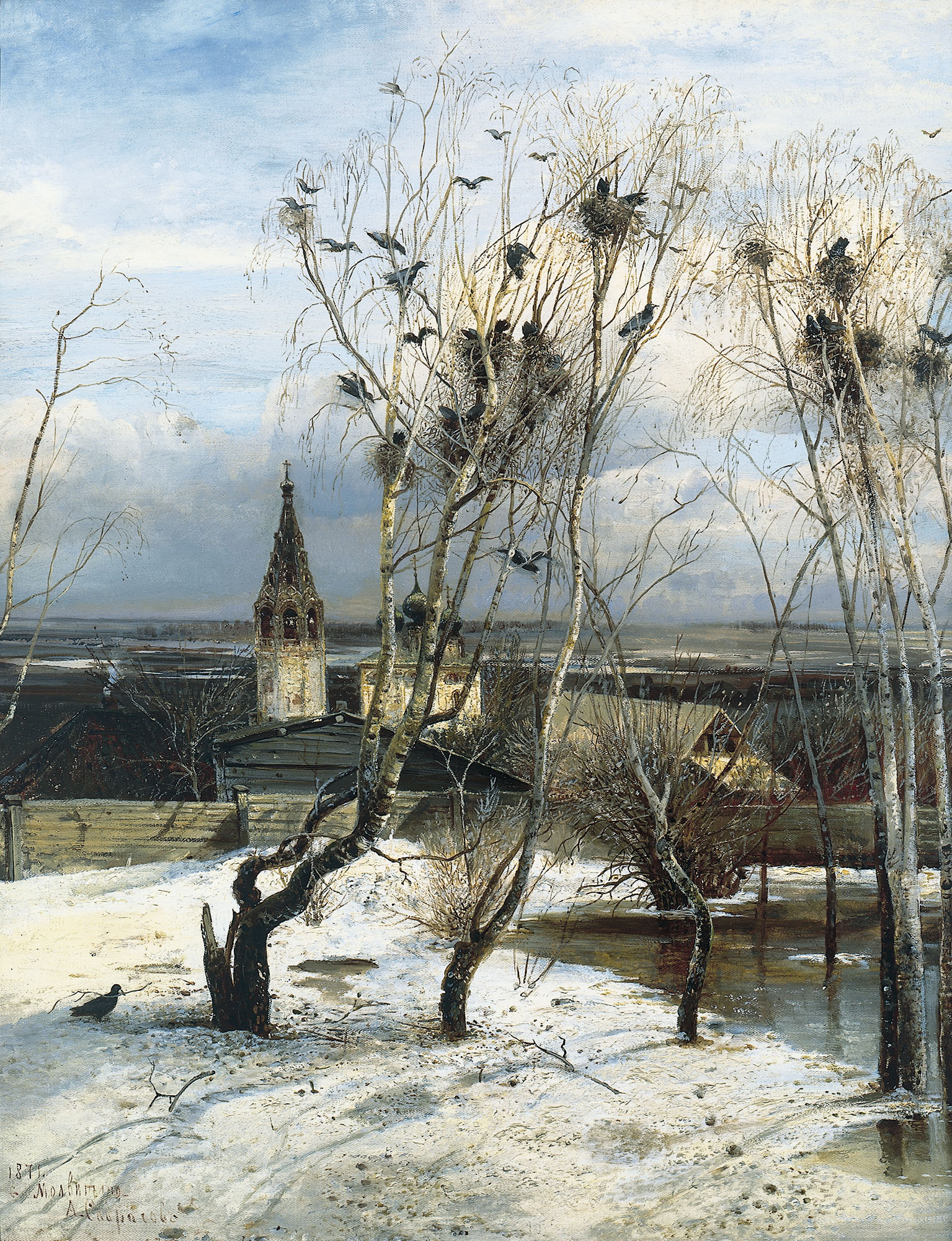 “The rooks have returned,” Alexei Savrasov, 1871.
To be continued.
 Fallen Leaves